For Software Engineers

Skills Beyond Code

Coding skill alone leaves engineers below the relevance bar AI raised. Skills beyond code are what lift them over it.

AI is changing what companies expect from engineers. Coding skill alone won't carry you anymore. What sets you apart: getting your point across, owning outcomes, making the judgment calls.

What you get here: hacks that get you taken seriously before you have the title. Short on-demand videos for situations you hit every week - ready to use right away.

TAKE A MOMENT AND THINK ABOUT YOUR JOB

Does That Sound Familiar?

If you’re nodding along to more than one point, there’s room to improve and it won’t come from writing more code.

The Fastest Way To Get Good At These

Battle-Proven Senior Hacks

Real workplace situations, the exact move that works, ready to use the same day

  • 100% software engineering workplace situations. Nothing generic
  • Fully on demand and online. Learn at your own speed
  • 60+ lessons, 5 to 15 minutes each
  • 14-day money-back guarantee. Lifetime course access.

Awarded with the BSFZ seal for innovation competence in 2025 and 2026MORE DETAILS
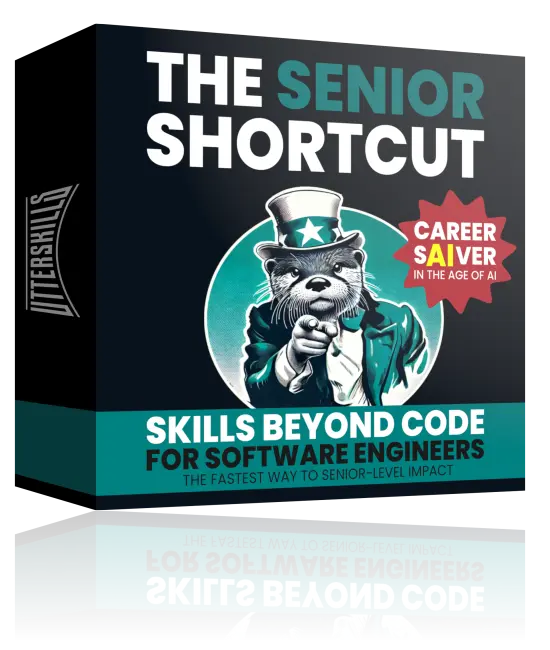
The Senior Shortcut course box by Utterskills, Skills Beyond Code for Software Engineers.

You'll learn how to...

  • ... be taken seriously before you have the title
  • ... say things so people actually act on them
  • ... explain tech to people who don't speak tech
  • ... back your calls with numbers, not opinions
  • ... ask the question without looking stupid
  • ... come across like a professional in meetings
  • ... turn feedback into your fastest way up
  • ... say no and get your day back
  • ... choose the career path that actually fits you
  • ... become the one they promote, not the one they cut
THE SOURCE

Built by senior engineers who already figured this out

Every hack comes from engineers who solved these exact situations at work.

100+

senior engineers in our network, whose hard-won lessons feed every hack in the course. One of the things we asked them: what are the 3 things you'd tell your younger self at the start of your developer career? You'd be amazed what they said.

Florian Schmidt

Florian Schmidt

Co-Founder

Developer to Director of Engineering. Sat through hundreds of interviews and saw one pattern decide every career.

READ HIS STORY
Pierluigi Meloni

Pierluigi Meloni

Co-Founder

Developer to executive leadership. Coaches engineers to say what they think and actually get heard in every room.

READ HIS STORY

“Learn in minutes what took them years.“

It worked for them:

I could write code. Speaking up was the part nobody taught me. The communication and business-thinking techniques gave me that confidence, and it contributed directly to my promotion.★★★★★

Review by Abhishek Nagekar

Abhishek Nagekar

Security Engineer, Mozilla

It gives you really practical tips on how communication with non-technical people works best. I'm way more confident now about when to speak up and how. Honestly, I couldn't find anything negative about it.★★★★★

Felix Vogel

Junior AI Engineer, AOE Group GmbH

Talking to decision-makers used to be the part of my job I was worst prepared for. Small, digestible sections, and it changed how I communicate with them.★★★★★

Review by Tim Bischoff

Tim Bischoff

Software Developer, Seidemann Web

I thought getting better technically was the whole game. This showed me what actually drives career growth: prioritization, communication, feedback, and how to work with people.★★★★★

Review by Kunal Mhatre

Kunal Mhatre

Frontend Engineer, Alef Education

The tips are from real tech workdays, not theory. They paid off directly in my last job application process.★★★★★

Review by Vilma L.

Vilma L.

Head of Technology, Whatever.Works

I expected another dry soft-skills course. Instead I got methods I could use at work the same week, delivered with actual humor.★★★★★

Review by Martin Hochstraßer

Martin Hochstraßer

Senior Software Developer, Inxmail

Nobody teaches you the beyond-the-code part of the job. This covers it, crisp and practical, without wasting your time.★★★★★

Review by Subhashini A.

Subhashini A.

Senior Engineer, Jobrad

I learned concrete methods for structuring big tasks and for approaching people at work. Engaging, easy to digest, no lecture-hall feeling.★★★★★

Florian Nägele

Linux System Administrator, qwertiko GmbH

As Head of Engineering, this is exactly what I look for beyond code: clear communication, collaboration, business thinking. Especially in developers who want client-facing or leadership roles.★★★★★

Review by Dung Nguyen

Dung Nguyen

Head of Engineering, NFQ Asia

I could write code. Speaking up was the part nobody taught me. The communication and business-thinking techniques gave me that confidence, and it contributed directly to my promotion.★★★★★

Review by Abhishek Nagekar

Abhishek Nagekar

Security Engineer, Mozilla

It gives you really practical tips on how communication with non-technical people works best. I'm way more confident now about when to speak up and how. Honestly, I couldn't find anything negative about it.★★★★★

Felix Vogel

Junior AI Engineer, AOE Group GmbH

Talking to decision-makers used to be the part of my job I was worst prepared for. Small, digestible sections, and it changed how I communicate with them.★★★★★

Review by Tim Bischoff

Tim Bischoff

Software Developer, Seidemann Web

I thought getting better technically was the whole game. This showed me what actually drives career growth: prioritization, communication, feedback, and how to work with people.★★★★★

Review by Kunal Mhatre

Kunal Mhatre

Frontend Engineer, Alef Education

The tips are from real tech workdays, not theory. They paid off directly in my last job application process.★★★★★

Review by Vilma L.

Vilma L.

Head of Technology, Whatever.Works

I expected another dry soft-skills course. Instead I got methods I could use at work the same week, delivered with actual humor.★★★★★

Review by Martin Hochstraßer

Martin Hochstraßer

Senior Software Developer, Inxmail

Nobody teaches you the beyond-the-code part of the job. This covers it, crisp and practical, without wasting your time.★★★★★

Review by Subhashini A.

Subhashini A.

Senior Engineer, Jobrad

I learned concrete methods for structuring big tasks and for approaching people at work. Engaging, easy to digest, no lecture-hall feeling.★★★★★

Florian Nägele

Linux System Administrator, qwertiko GmbH

As Head of Engineering, this is exactly what I look for beyond code: clear communication, collaboration, business thinking. Especially in developers who want client-facing or leadership roles.★★★★★

Review by Dung Nguyen

Dung Nguyen

Head of Engineering, NFQ Asia

I could write code. Speaking up was the part nobody taught me. The communication and business-thinking techniques gave me that confidence, and it contributed directly to my promotion.★★★★★

Review by Abhishek Nagekar

Abhishek Nagekar

Security Engineer, Mozilla

It gives you really practical tips on how communication with non-technical people works best. I'm way more confident now about when to speak up and how. Honestly, I couldn't find anything negative about it.★★★★★

Felix Vogel

Junior AI Engineer, AOE Group GmbH

Talking to decision-makers used to be the part of my job I was worst prepared for. Small, digestible sections, and it changed how I communicate with them.★★★★★

Review by Tim Bischoff

Tim Bischoff

Software Developer, Seidemann Web

I thought getting better technically was the whole game. This showed me what actually drives career growth: prioritization, communication, feedback, and how to work with people.★★★★★

Review by Kunal Mhatre

Kunal Mhatre

Frontend Engineer, Alef Education

The tips are from real tech workdays, not theory. They paid off directly in my last job application process.★★★★★

Review by Vilma L.

Vilma L.

Head of Technology, Whatever.Works

I expected another dry soft-skills course. Instead I got methods I could use at work the same week, delivered with actual humor.★★★★★

Review by Martin Hochstraßer

Martin Hochstraßer

Senior Software Developer, Inxmail

Nobody teaches you the beyond-the-code part of the job. This covers it, crisp and practical, without wasting your time.★★★★★

Review by Subhashini A.

Subhashini A.

Senior Engineer, Jobrad

I learned concrete methods for structuring big tasks and for approaching people at work. Engaging, easy to digest, no lecture-hall feeling.★★★★★

Florian Nägele

Linux System Administrator, qwertiko GmbH

As Head of Engineering, this is exactly what I look for beyond code: clear communication, collaboration, business thinking. Especially in developers who want client-facing or leadership roles.★★★★★

Review by Dung Nguyen

Dung Nguyen

Head of Engineering, NFQ Asia

Companies like these train their engineers in exactly this:

inxmail
norisk
Liveo Research GmbH
Scale Commerce
NFQ Asia
JobRad
Xebia
qweriko
unit m
Seidemann Web
ixomo GmbH
Sölter Consultants GmbH
inxmail
norisk
Liveo Research GmbH
Scale Commerce
NFQ Asia
JobRad
Xebia
qweriko
unit m
Seidemann Web
ixomo GmbH
Sölter Consultants GmbH
Compare for yourself

Pick Your Upgrade

Of course, you can find infinite career advice online for free. But sorting through hours of generic YouTube advice that was never written for engineers costs the most expensive asset you have: your time and your nerves. Utterskills is the filter that isolates exactly what matters for your daily work as an engineer.

The Source
Utterskills

Built by seniors who've been there

YouTube(social platforms)

Social media creators optimizing for clicks and broad audiences.

Generic Corporate Training

HR consultants who have never touched code.

Curation Level
Utterskills

100% focused on engineering scenarios. Ready-to-use hacks for your daily routine.

YouTube(social platforms)

0%: You have to search, test, and filter through hours of generic “how to be confident” advice yourself.

Generic Corporate Training

Standard corporate compliance packages and high-level behavioral theory.

The Commitment
Utterskills

5 to 15 minutes per video. You watch it during a break and use it in your next standup.

YouTube(social platforms)

Days of endless scrolling through generic advice.

Generic Corporate Training

Two full days of slow-paced, awkward group workshops.

The Price
Utterskills

One-time payment (299€) for lifetime access to the complete expert knowledge.

YouTube(social platforms)

"Free of charge" - but you pay with your time to find any useful information yourself.

Generic Corporate Training

Expensive corporate budgets.

Three ways to build the skills beyond code you need.

“Only one is 100% focused on your daily reality as an engineer and nothing else.”

Frequently Asked Questions

Every engineer needs this skill set now. The pure coder role does not exist anymore. It does not matter whether you are in your first month or five years in with your focus almost entirely on code. What matters is where you stand on skills beyond code, not how senior your title is.

If you have shipped solid work and then watched someone else get asked the interesting question about it, this is for you.
No. Starting now is the smarter move.

The industry shift does not really leave you a choice. These skills have to be visible today, not next year. And there is an asymmetry worth noticing: AI can clean up your code. It cannot handle the conversation where you explain the tradeoff, push back on a bad ticket, or make your work visible to the person who decides what happens to your role.

That part is still on you, and it is the part that is getting scarce.
Not reliably. We know plenty of excellent engineers who spent years going deep on code and nothing else, and they are having a hard time on the job market right now.

There is also a difference in how you learn the two things. With code you are alone first. You can fail quietly, take your time, rewrite it, ship it when it is good. With people there is no draft. It is live, the feedback is immediate, and the awkward version is the one everyone remembers.

The course exists so you skip the expensive version of that trial and error and show up prepared instead.
Around work, whenever you want. Everything is on demand.

60+ lessons, 10 to 15 minutes each. No schedule, no live calls. One lesson fits in a break.

The lessons do not build on each other in a strict order. They are small, practical moves you can learn in a break and use in the next meeting.
Yes, a completion certificate for your CV, your LinkedIn profile, or your next performance review. It is a visible marker that you worked on the part most engineers skip, and the part hiring managers actually pay attention to.

We have had alumni tell us they got interviews, and in some cases the job, because they answered questions exactly the way they practiced in the course. The certificate made it official on paper.
Usually yes. A lot of engineers cover it from a team training budget.

We include a "convince your boss" template with the arguments already written out, and we invoice properly for company purchases.
The course is in English only, on purpose. English is the language of the industry. You will rarely land on a team that is not multinational, and the working language there is English.

You do not need native-level English to follow it. The vocabulary is everyday engineering work, the kind of language you already use in code reviews, tickets, and team calls.
Full breakdown on the course page.
THE INDUSTRY IS SHIFTING

Engineering roles are changing. Now!

AI writes more of the code every quarter. What's left is the part it can't do: communication, ownership, judgment. That's what companies are screening now, at every level.

That's exactly what you train here.

SEE THE OFFERQUESTIONS? REACH OUT
NOT JUST US SAYING IT
Gergely Orosz

Gergely Orosz

Author of The Software Engineer's Guidebook & Publisher of The Pragmatic Engineer, Former Engineering Manager at Uber

"The most difficult thing about software engineering is almost always the people, the communication, and the alignment - not the code. Experienced engineers know this; juniors rarely do."
Jensen Huang

Jensen Huang

CEO of NVIDIA

"AI will write most of the code. The actual value of an engineer will move up the stack: defining the problem, understanding the user, orchestrating architecture, and deciding what not to build."