The question isn’t who uses ChatGPT or Copilot - it’s who builds the teams resilient enough to adapt when the tools, prices, or platforms inevitably change. Long-term advantage won’t come from technology. It will come from leadership.
This is the third and final article in our series on skills beyond code. Here, we’ll explore how business owners can create resilient, human-centered teams that turn AI into a sustainable competitive edge.
Every company will have access to the same AI. Clarity is the advantage.
FutureSearch analysis: OpenAI cut its API prices repeatedly through 2024 and 2025 - GPT-4o input tokens alone dropped 50% in one update - as Anthropic and Meta’s open models forced a price war. For startups reselling that API access at a markup, the math turned overnight: mark up tokens 3x, and a 50% price cut takes your margin from 200% to 50%. DEV.to analysis: AI “wrapper” startups now average around 23% gross margins, against 70-90% for traditional SaaS, and need roughly three times as much funding to reach profitability. These companies had placed their entire strategy on someone else’s pricing, with no backup plan and no human adaptability built into their teams.
For business owners, the lesson is clear: AI gives you tools, but only human resilience ensures you can withstand disruption.
Why resilience matters
Generative AI is evolving faster than any previous technology. Today’s breakthrough model can be tomorrow’s commodity. Pricing, availability, and competitive offerings shift constantly.
Technical skills alone won’t protect your business - they age out too quickly. What endures is your people’s ability to:
- Adapt when platforms change.
- Reframe problems when tools fail.
- Navigate uncertainty with judgment and creativity.
That’s resilience. And it must be trained.
Skills beyond code required: Adaptability, continuous learning, and strategic foresight.
Why resilience matters: Tech changes faster than skills, but human adaptability endures.
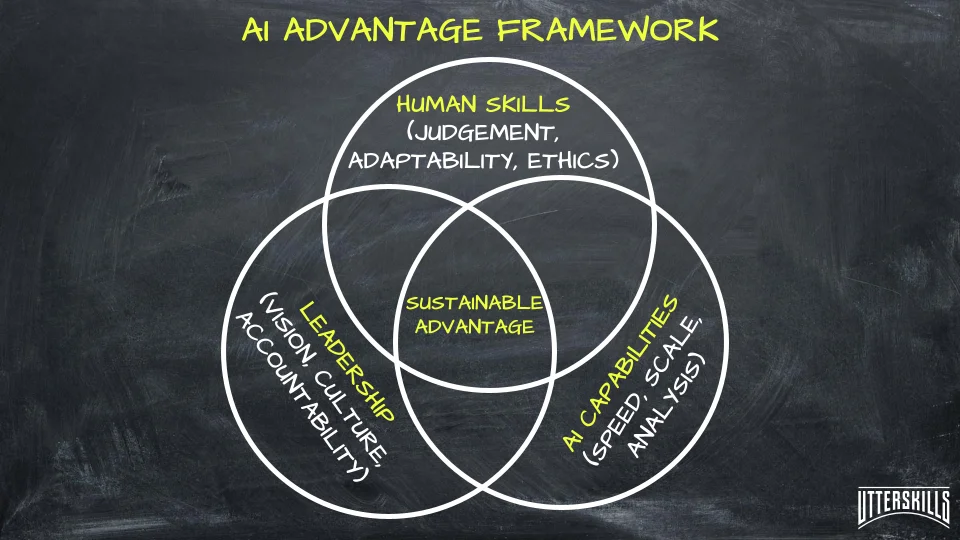
The AI advantage framework
If AI is to become a true advantage, leaders must design human-in-the-loop systems where staff complement AI, not just consume it. In a strategy session, that means AI generates options once humans have framed the actual problem - run it the other way around and you get plausible-sounding plans for the wrong question. In compliance and risk reviews, it means AI flags the anomalies a person would take hours to find, but a person still decides what to do about each one. And in complex analysis, AI can surface patterns across more data than any team could review by hand, but only a person can turn those patterns into a narrative that weighs trade-offs and makes the call.
This partnership is more than efficiency. It’s resilience - the ability to shift, adapt, and innovate even when the tech landscape changes.
The role of leadership
Resilience doesn’t happen by accident. It’s a leadership choice.
As an owner, your job is to:
- Upskill your teams in judgment, adaptability, and ethical reasoning.
- Foster psychological safety, so employees feel free to question AI outputs without fear.
- Model humility - knowing when to trust the tool and when to challenge it.
Without leadership, AI adoption becomes a gamble. With leadership, it becomes a durable advantage.
Frequently Asked Questions
Owners: build the advantage that lasts
AI will level the technical playing field. Every competitor will have access to the same powerful models.
Your advantage won’t come from the tools. It will come from the human skills your teams develop beyond code: adaptability, resilience, and leadership.
That’s the thread running through this series: AI can execute, but it can’t adapt on its own, hold itself accountable, or lead a team through change. Only your people can do that - and building it takes deliberate investment, not a better prompt.
The choice for owners is simple: treat AI as a shortcut and risk fragility, or invest in your people and build an advantage that endures.