Every software engineer career ladder describes the level above you. What it rarely spells out is that most of the difference between junior, senior and staff isn't about code.
Review season. You pull up your quarter: most tickets closed on the team, two nasty bugs nobody else could pin down, a clean PR history. Your lead says it was a strong quarter. Then, almost in passing: “For the next level, we'd like to see a bit more ownership.” You nod, walk back to your desk, and have no idea what to do differently on Monday.
That word, ownership, or visibility, or impact, is the career ladder talking. It's just talking in a language nobody taught you. This post translates it: what each level of a software developer career asks of you, where the paths split after senior, and what actually gets you promoted.
What is a software engineer career ladder?
A software engineer career ladder is the list of levels in an engineering organisation, usually something like junior, mid-level, senior, staff and principal, plus a parallel management track, together with what's expected at each one. A good ladder tells you what changes from one level to the next: not the years you've put in, but the scope you own, the judgment you show, and how well you work with people.
The catch: our industry never agreed on one. If you want to be a lawyer or a doctor, the steps are fixed. Training, exams, certifications, and a clear list of what you have to show before you move up. Software has almost none of that. No binding standards, hardly any entry barriers. It's an open house: everyone's welcome, bring a friend. Look around your own team and count how many people came in from a completely different background.
That openness is good for the industry, but it has a side effect: the levels mean something different everywhere. Search for “software engineer career ladder” and you'll find dozens of versions, some three rungs, some twelve, each company with its own titles. So the title on your contract says less than you'd think.
What stays fairly constant across all of them is what each level adds. And when you line those additions up, a pattern shows up quickly.
Skills needed for a software developer at each level
Look up the requirements and skills for a software engineer and you mostly get lists of languages and frameworks. For a long time that was exactly the right focus for a junior: learn the craft, get to know the codebase, get good at the technical part. Everything else could wait until senior.
That has changed. AI writes more of the code every quarter, and being a good coder is turning into the baseline rather than the thing that sets you apart. The technical ramp-up still matters, but the skills further down the ladder now show up on your plate much earlier than they used to.
This is the ladder we use throughout the Utterskills course, built by comparing many of the public versions with what we've seen in real teams. We leave the technical skills out on purpose, not because they don't matter, but because they're covered well enough elsewhere. What's left is the part that decides who moves. Each level keeps everything from the one before and adds to it.
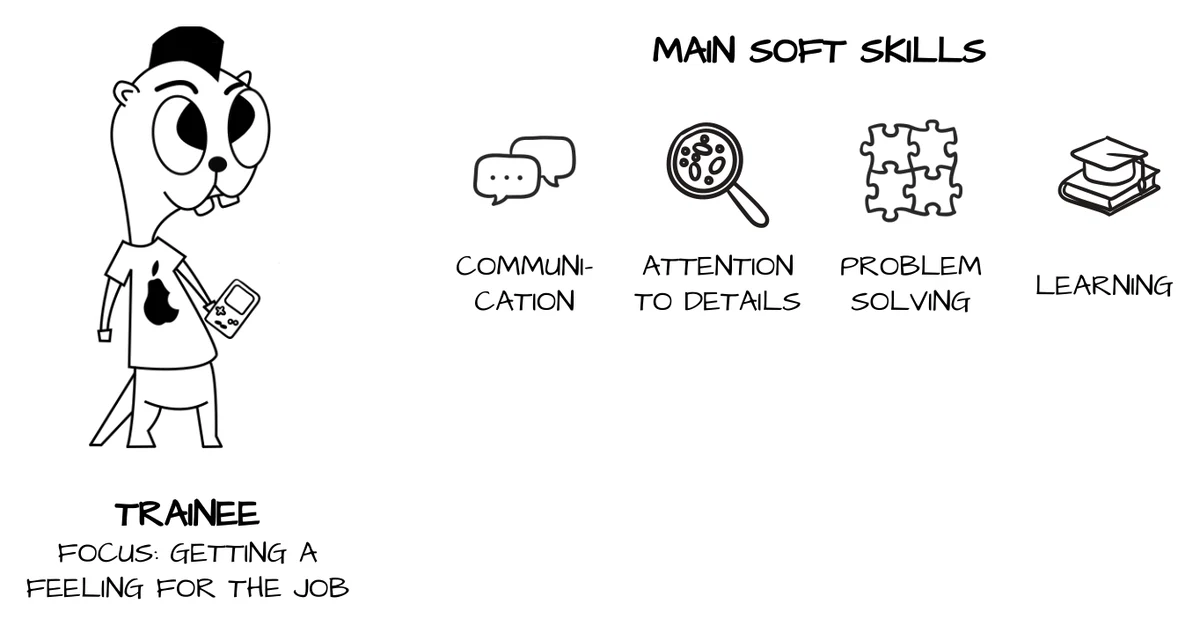
Trainee: getting a feeling for the job
No professional experience yet, learning at home or in an internship, working under someone's supervision. What matters here: communication, which mostly means asking questions without flinching and listening properly, attention to detail, a real appetite for solving problems, and learning fast, because the tools will change under you anyway.
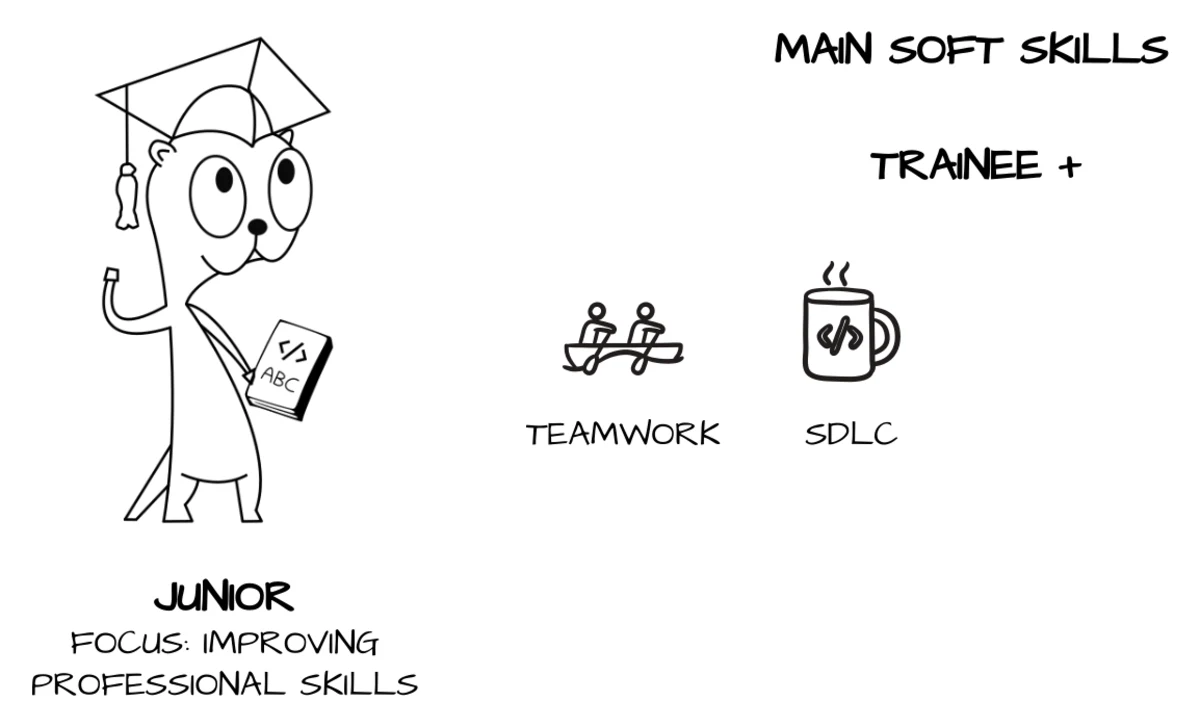
Junior: improving your professional skills
Roughly two to three years in. Your first real contract. You write, test and fix code under the guidance of seniors. On top of the trainee basics you add teamwork, because you work with other people on shared code every single day, and a working picture of the software development life cycle (SDLC): planning, analysis, design, implementation, testing, integration, maintenance. Not mastery, just knowing where your ticket sits in it. Most of your energy here still goes into the technical side, and it should. Just don't let “code first” quietly turn into “code only.” The rest of this list starts now, in the background, not after you make senior.
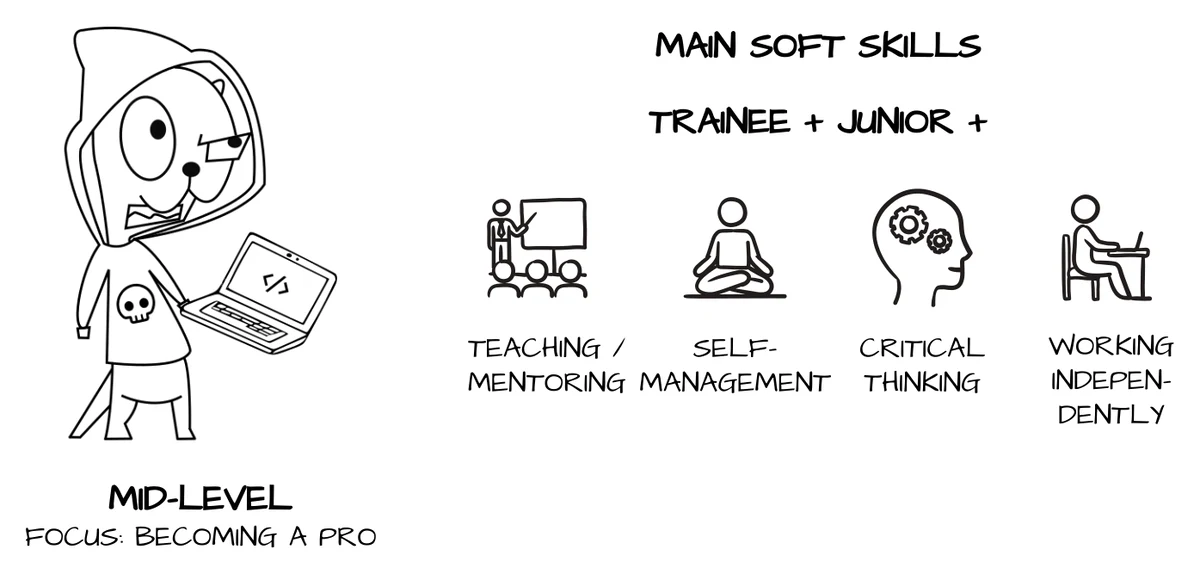
Mid-level: becoming a pro
Roughly three to six years in. You build and maintain complex parts of the system and you start mentoring juniors. That adds teaching and mentoring, self-management (juggling several tasks, priorities and the expectations attached to them), working independently, and critical thinking. You're the expert now. Doubt things, come up with alternatives, and make sure you're actually heard.
Senior software engineer: owning the tech and becoming a leader
Roughly seven years and up. You lead development, make technical decisions and give the team technical direction. The additions: a strong work ethic, because people now copy what you do. Leadership, mostly technical, with a feel for group dynamics. Handling superiors, or managing your own managers. Seeing the big picture, which includes turning complex problems into short summaries a non-engineer can act on. And business acumen, because engineering isn't an end in itself, it serves a goal someone is paying for.
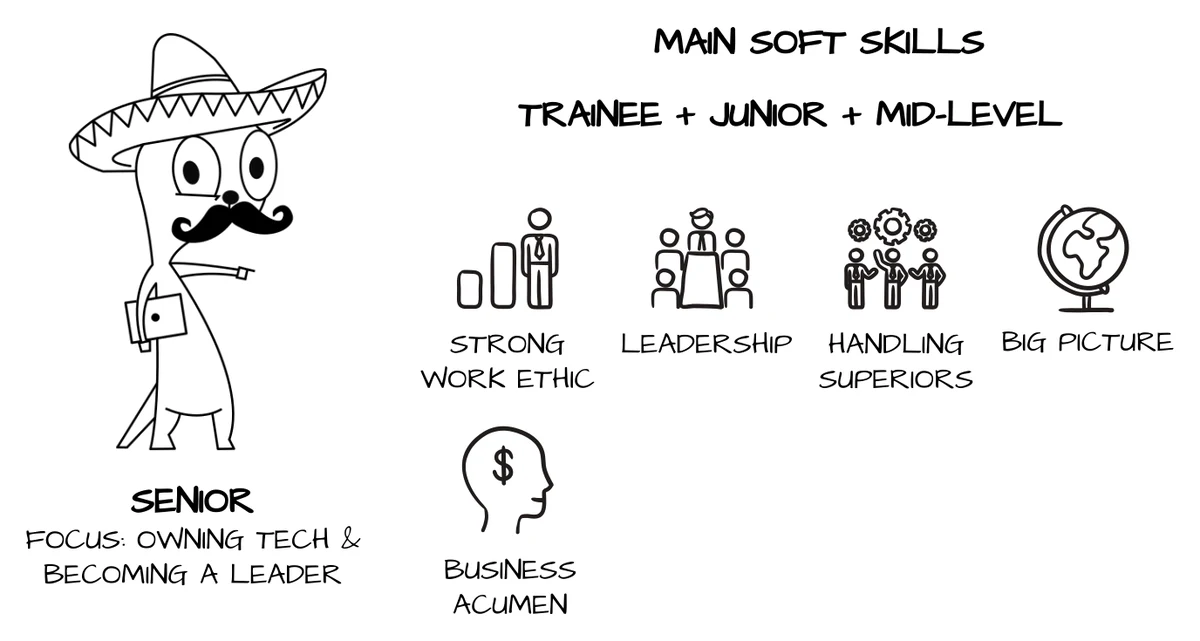
Read that top to bottom and notice how rarely code shows up. The year ranges are typical, not a timer. Two engineers with the same years and the same technical level can sit on different rungs, and the difference is almost always on this list.
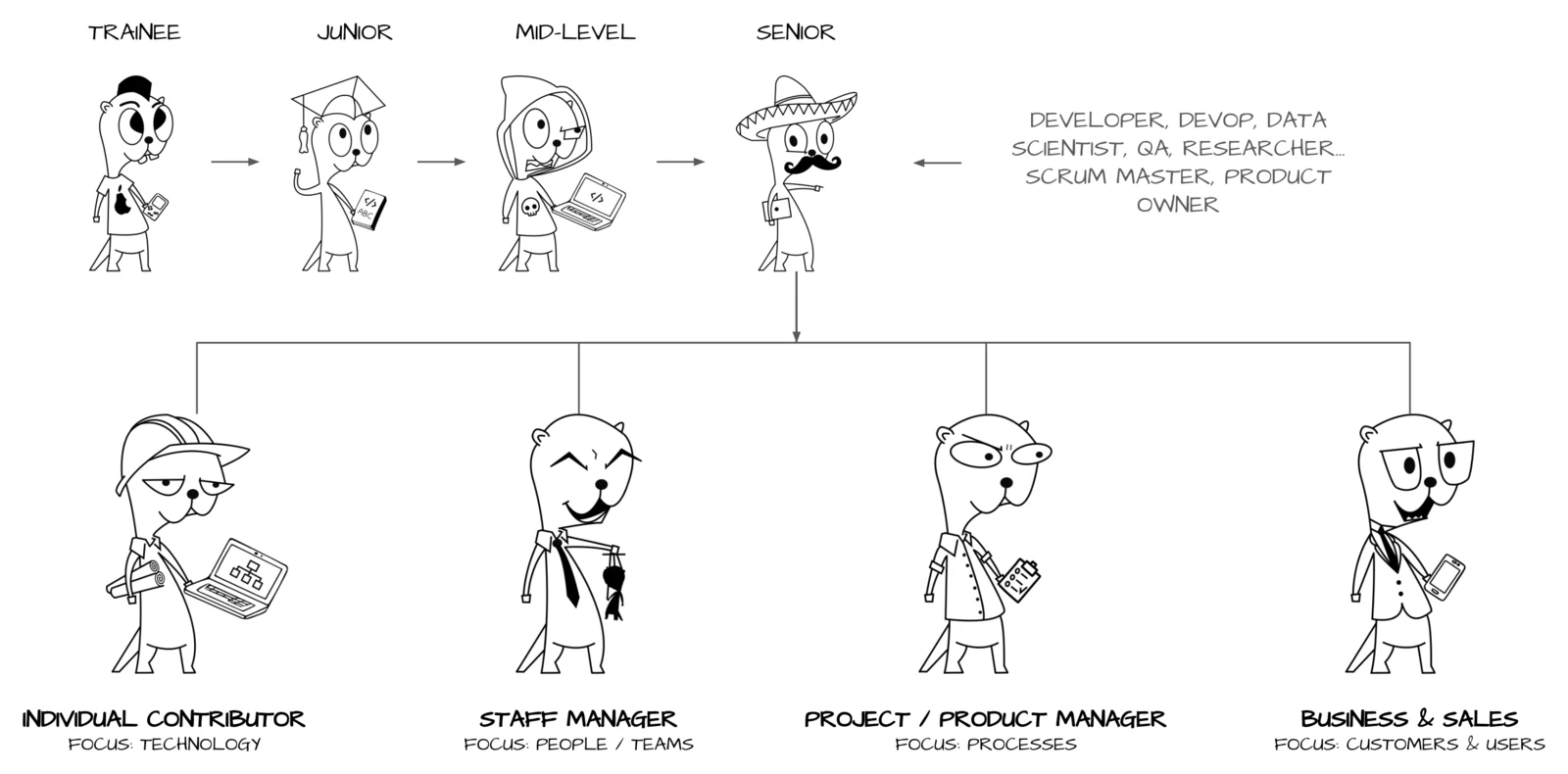
The ladder doesn't only go straight up, either. Right after junior, plenty of people branch into DevOps, data science, QA, research, or roles like Scrum Master and Product Owner. Same logic applies there: the technical skills change, the list above mostly doesn't.
Where a software developer career goes after senior
Here's where the industry gets it a bit wrong. There's no one-star, two-star, three-star senior like there are ranks in the military. So if you want to keep moving after senior, the default road often leads into management. We take the most specialised engineers and hand them a job built on a completely different skill set, and then act surprised when it doesn't work.
It helps to know there's more than one direction. Most company ladders split into an individual contributor track and a management track. We go one step further and group what comes after senior into four paths:
| Path | Focus | Typical roles | Main skills |
|---|---|---|---|
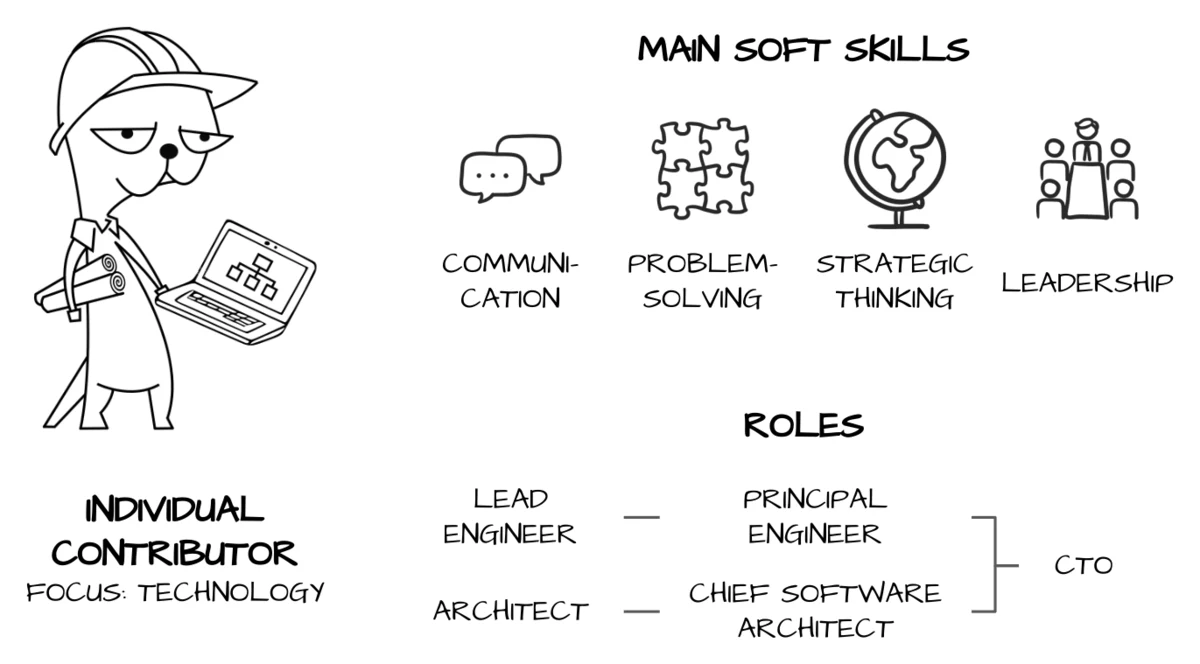
| Staff engineer (individual contributor) | Technology | Lead engineer, staff engineer, principal engineer, architect, chief software architect, CTO | Communication, problem solving, strategic thinking, leadership |
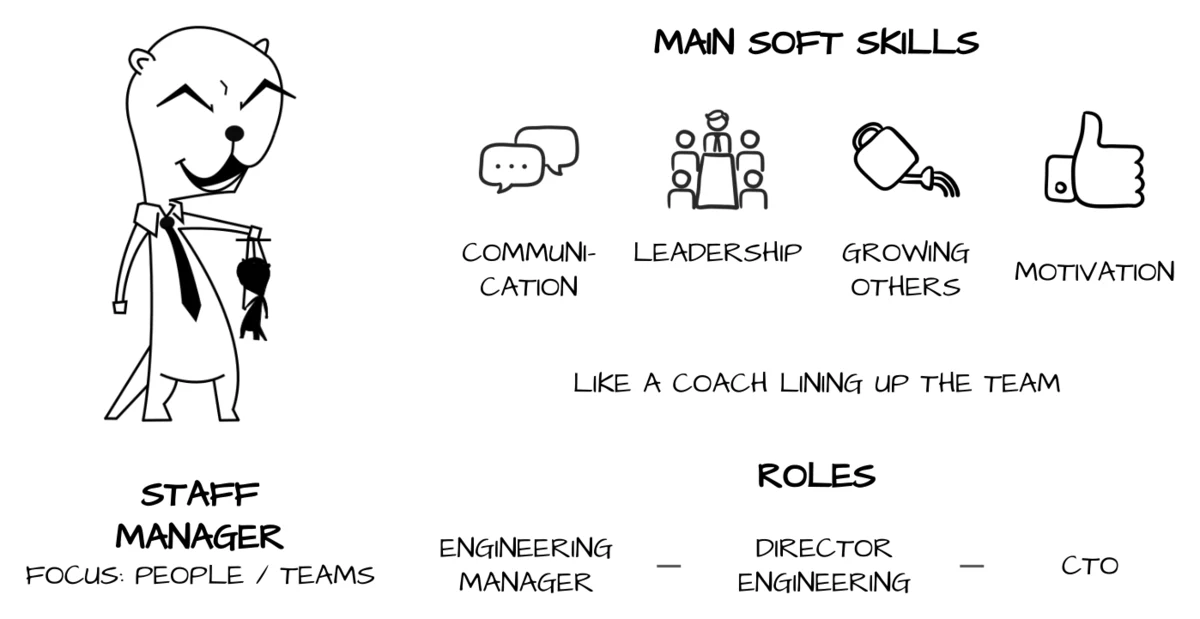
| Engineering manager | People and teams | Engineering manager, director of engineering, CTO | Communication, leadership, growing others, motivation |
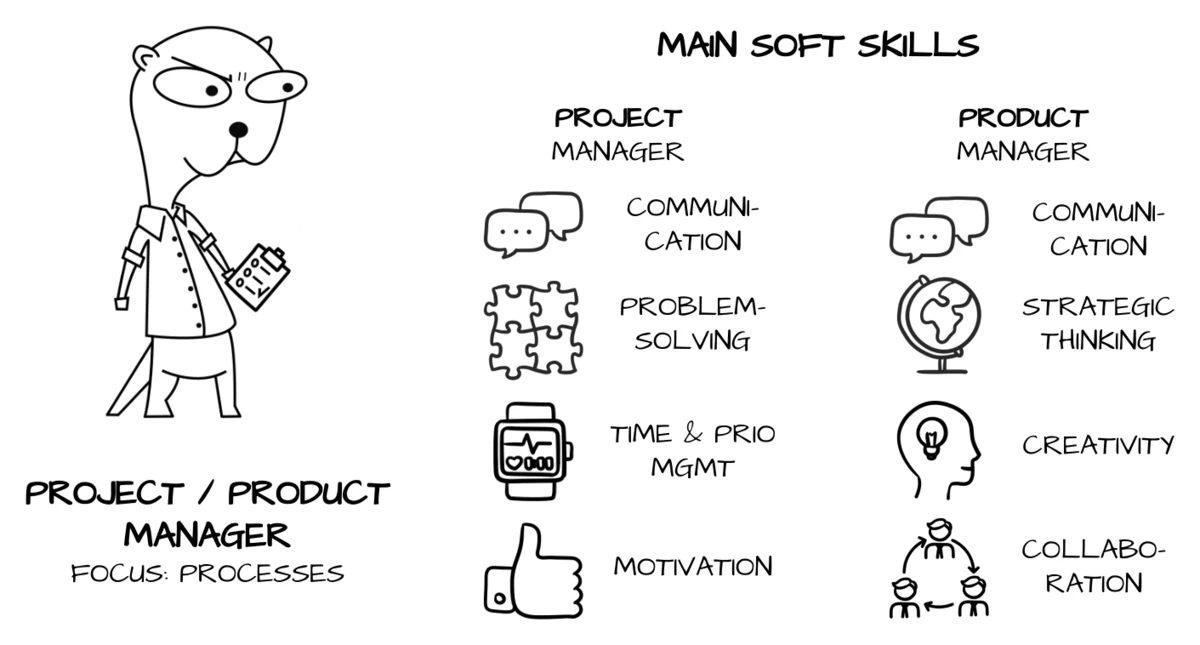
| Project or product manager | Processes | Project manager, product manager, technical program manager | Communication, plus problem solving and time management (project) or strategic thinking and creativity (product) |
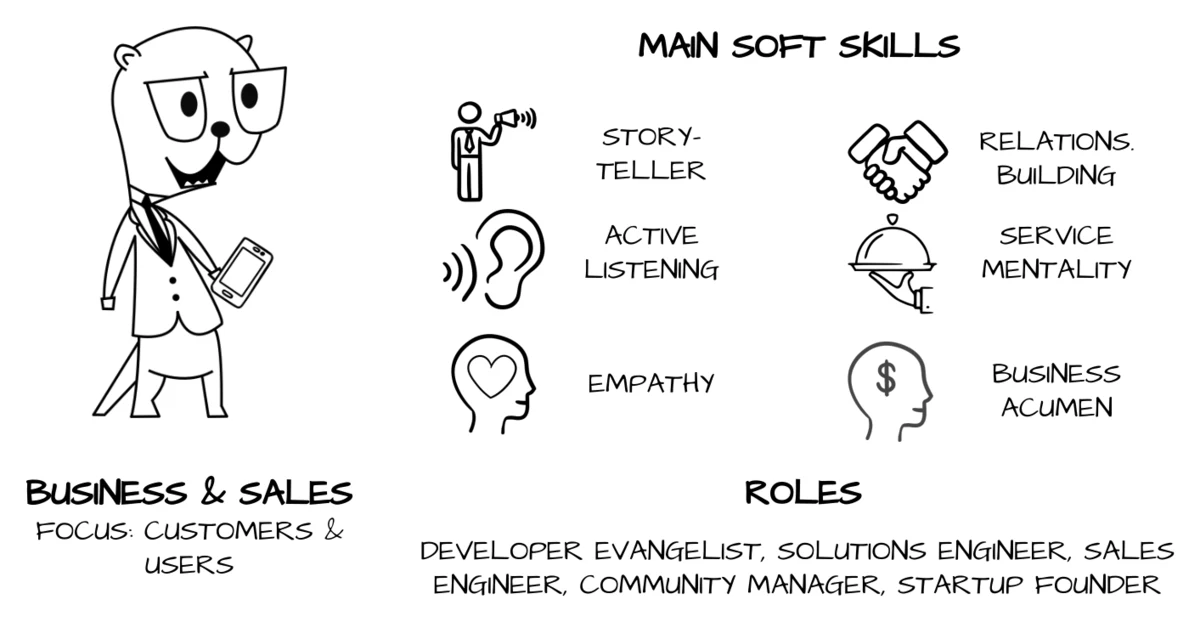
| Business and sales | Customers and users | Developer evangelist, solutions engineer, sales engineer, community manager, startup founder | Storytelling, active listening, empathy, relationship building, service mindset, business acumen |
Tech lead
Before the paths split, many seniors make a stop as tech lead. At most companies that's a role, not a level: a senior engineer who takes technical responsibility for one team. You set the technical direction, break the work down, unblock people, and you're the one the product manager talks to. You still write code, just less of it. What you usually don't do is the people side: reviews, salaries, hiring. That makes tech lead a good place to find out which way you lean. If the technical decisions are the part you like, look at the staff engineer path. If it's getting the team to work well together, look at engineering manager.
Staff engineer (the individual contributor path)
The most natural next step, the focus stays on technology. This is where staff and principal engineers usually sit, and where leadership means technical leadership: people trust your decisions and copy how you work. Architects sit a bit further from daily implementation and focus on concepts, guidance and a structure that lasts. To get here you have to drop some familiar habits: doing everything yourself, disappearing into tunnel mode, being the know-it-all, and complaining.
Engineering manager
The focus moves to people. This is the management track: engineering manager first, with director of engineering further up. Don't confuse it with staff engineer, which is an IC role despite the similar ring. You still need solid technical knowledge, but the job is creating the conditions for a team to perform, and growing and promoting talent. Think of a coach lining up the team: you prepare everyone, but the team plays the game.
Project or product manager
These two are more different than they look. A project manager lives on time and budget and has to be a sharp problem solver. A product manager thinks longer-term and often has no team of their own, so they get things done through collaboration and creativity. Both can grow into technical program manager, coordinating several projects or products towards one goal.
Business and sales
Close to users and customers, often working alone. Evangelists and community managers are public faces who have to keep an audience interested. Solutions and sales engineers sit with one client at a time and have to really understand their situation. A newer role close to these is the forward deployed engineer, who also sits with one customer but builds the solution in their environment. Founding your own startup lands here too.
None of these sits above the others, and moving between the IC and management track later is common and healthy. It's like a football team: everyone plays football, but a striker, a midfielder and a defender need very different strengths. You don't have to pick today. But knowing which way you're leaning tells you which skills to start building now.
Why coding skill alone doesn't get you promoted
Here's a story we heard in different versions from the engineers and leads we interviewed for the course. Call the engineer Jonas. It's a composite, but every piece of it happened to someone.
Two years in, Jonas was one of the strongest coders on his team. In a planning meeting he said the auth refactor would “get messy” if it kept slipping. People nodded, and it slipped again. A few months later a colleague with less technical depth got the mid-level title. What she'd done differently was small: when she raised a risk, she said what it would cost and what she'd do instead, and she said it early enough to matter.
Jonas didn't need to get better at code. He changed one thing. Before the next planning meeting he sent his lead a three-line note: what's wrong, what it costs if we skip it (hotfixes eating about a day every sprint), and a smaller first step the team could take. It got scheduled. He did the same before the next two plannings. By the following review, “a bit more ownership” had turned into a concrete example his lead brought up without being asked.
So here is the new reality
Whatever your company's ladder looks like, a promotion confirms work you're already doing at the next level. Consistently, not occasionally. It doesn't reward waiting. And the work has to be seen: promotions don't go to the best coder, they go to the engineer whose impact is visible.
And the list above is getting more important, not less. Writing code is getting cheaper, a lot of it now starts as a model's draft. Kent Beck put it bluntly: “The value of 90% of my skills just dropped to $0. The leverage for the remaining 10% went up 1000x.” What doesn't get cheaper is the stuff on the senior list: deciding what should be built, explaining a risk so someone acts on it, taking responsibility for what gets shipped. The requirement is shifting, the job isn't vanishing. The part you were trained for is becoming the baseline, and the part that moves you up is the part nobody taught you.
What to actually do about it: how to show next-level work this month
You don't need to work through the whole list. You need one item, shown in the right place.
Take the list for the level above you and pick one thing. Choose something you can show in a moment that already happens every week: a planning, a refinement, a code review, a 1:1.
If you're heading for mid-level, try critical thinking out loud. Next time something in a ticket looks off, say it in one sentence with the consequence attached, and bring an alternative. “This assumes the payment API answers synchronously, it doesn't, so we'll see failed checkouts under load. We could queue it instead.”
If you're heading for senior, try the summary. Next time you explain a technical problem to your lead, add three lines a non-engineer could forward: what's wrong, what it costs, what you propose.
Then ask for the gap directly. In your next 1:1: “Which next-level behaviour do you already see from me, and which one is missing?” That turns “a bit more ownership” into something you can work on by Monday.
Do that one thing for a month, visibly, and the next review conversation starts from a different place.
Zoom out, and the whole software engineer career ladder looks like this: trainee to senior, then one of four directions.
FAQ
Utterskills trains the skills beyond code that decide who advances: communication, ownership, and judgment. Built for devs, usable the same day.