The Senior Shortcut
Skills beyond code: 60+ micro-learning episodes from senior engineers who've been there, plus ready-to-use AI prompts for real situations at work. Your fastest path to senior-level impact.
One-time payment. Lifetime access. 14-day money-back guarantee.
What Our Alumni Say
I could write code. Speaking up was the part nobody taught me. The communication and business-thinking techniques gave me that confidence, and it contributed directly to my promotion.★★★★★

Abhishek Nagekar
Security Engineer, Mozilla
It gives you really practical tips on how communication with non-technical people works best. I'm way more confident now about when to speak up and how. Honestly, I couldn't find anything negative about it.★★★★★
Felix Vogel
Junior AI Engineer, AOE Group GmbH
Talking to decision-makers used to be the part of my job I was worst prepared for. Small, digestible sections, and it changed how I communicate with them.★★★★★

Tim Bischoff
Software Developer, Seidemann Web
I thought getting better technically was the whole game. This showed me what actually drives career growth: prioritization, communication, feedback, and how to work with people.★★★★★

Kunal Mhatre
Frontend Engineer, Alef Education
The tips are from real tech workdays, not theory. They paid off directly in my last job application process.★★★★★

Vilma L.
Head of Technology, Whatever.Works
I expected another dry soft-skills course. Instead I got methods I could use at work the same week, delivered with actual humor.★★★★★

Martin Hochstraßer
Senior Software Developer, Inxmail
Nobody teaches you the beyond-the-code part of the job. This covers it, crisp and practical, without wasting your time.★★★★★

Subhashini A.
Senior Engineer, Jobrad
I learned concrete methods for structuring big tasks and for approaching people at work. Engaging, easy to digest, no lecture-hall feeling.★★★★★
Florian Nägele
Linux System Administrator, qwertiko GmbH
As Head of Engineering, this is exactly what I look for beyond code: clear communication, collaboration, business thinking. Especially in developers who want client-facing or leadership roles.★★★★★

Dung Nguyen
Head of Engineering, NFQ Asia
I could write code. Speaking up was the part nobody taught me. The communication and business-thinking techniques gave me that confidence, and it contributed directly to my promotion.★★★★★
Abhishek Nagekar
Security Engineer, Mozilla
It gives you really practical tips on how communication with non-technical people works best. I'm way more confident now about when to speak up and how. Honestly, I couldn't find anything negative about it.★★★★★
Felix Vogel
Junior AI Engineer, AOE Group GmbH
Talking to decision-makers used to be the part of my job I was worst prepared for. Small, digestible sections, and it changed how I communicate with them.★★★★★
Tim Bischoff
Software Developer, Seidemann Web
I thought getting better technically was the whole game. This showed me what actually drives career growth: prioritization, communication, feedback, and how to work with people.★★★★★
Kunal Mhatre
Frontend Engineer, Alef Education
The tips are from real tech workdays, not theory. They paid off directly in my last job application process.★★★★★
Vilma L.
Head of Technology, Whatever.Works
I expected another dry soft-skills course. Instead I got methods I could use at work the same week, delivered with actual humor.★★★★★
Martin Hochstraßer
Senior Software Developer, Inxmail
Nobody teaches you the beyond-the-code part of the job. This covers it, crisp and practical, without wasting your time.★★★★★
Subhashini A.
Senior Engineer, Jobrad
I learned concrete methods for structuring big tasks and for approaching people at work. Engaging, easy to digest, no lecture-hall feeling.★★★★★
Florian Nägele
Linux System Administrator, qwertiko GmbH
As Head of Engineering, this is exactly what I look for beyond code: clear communication, collaboration, business thinking. Especially in developers who want client-facing or leadership roles.★★★★★
Dung Nguyen
Head of Engineering, NFQ Asia
I could write code. Speaking up was the part nobody taught me. The communication and business-thinking techniques gave me that confidence, and it contributed directly to my promotion.★★★★★
Abhishek Nagekar
Security Engineer, Mozilla
It gives you really practical tips on how communication with non-technical people works best. I'm way more confident now about when to speak up and how. Honestly, I couldn't find anything negative about it.★★★★★
Felix Vogel
Junior AI Engineer, AOE Group GmbH
Talking to decision-makers used to be the part of my job I was worst prepared for. Small, digestible sections, and it changed how I communicate with them.★★★★★
Tim Bischoff
Software Developer, Seidemann Web
I thought getting better technically was the whole game. This showed me what actually drives career growth: prioritization, communication, feedback, and how to work with people.★★★★★
Kunal Mhatre
Frontend Engineer, Alef Education
The tips are from real tech workdays, not theory. They paid off directly in my last job application process.★★★★★
Vilma L.
Head of Technology, Whatever.Works
I expected another dry soft-skills course. Instead I got methods I could use at work the same week, delivered with actual humor.★★★★★
Martin Hochstraßer
Senior Software Developer, Inxmail
Nobody teaches you the beyond-the-code part of the job. This covers it, crisp and practical, without wasting your time.★★★★★
Subhashini A.
Senior Engineer, Jobrad
I learned concrete methods for structuring big tasks and for approaching people at work. Engaging, easy to digest, no lecture-hall feeling.★★★★★
Florian Nägele
Linux System Administrator, qwertiko GmbH
As Head of Engineering, this is exactly what I look for beyond code: clear communication, collaboration, business thinking. Especially in developers who want client-facing or leadership roles.★★★★★
Dung Nguyen
Head of Engineering, NFQ Asia
The Course Syllabus
The curriculum is built around 7 core success factors identified through in-depth interviews with 100+ senior engineers and engineering managers.
"If you don't know where you're going, any road will take you there."— Lewis Carroll
From Our Interviews: Meet Gigi
From day one, I had one goal: Senior Developer. I coded, pushed through tasks, and climbed the straight line ahead of me. At 28 I got the title. The surprise: while most others seemed happy, I wasn't. It felt empty. The work drained me, I felt stuck.
Fortunately, I had a Director of Product who noticed what I was missing. I was an okay coder, but I was an exceptional communicator and strategist. I naturally bridged the gap between business and tech. She pulled me into a trial as a Product Manager, and it clicked instantly. That was a path I had never even considered.
The Lesson
Gigi succeeded, but it took a sharp realization: he wasted years. He relied on pure luck for a manager to spot his talent. If he had audited his strengths early instead of blindly chasing a default title, he could have built a career he loved years sooner.
In this industry you can easily spend years being busy grinding through tickets. Whether you actively define a direction or not, time moves anyway. If you don't intentionally choose your trajectory, you will simply default to wherever your current company or the market pushes you. Defining a clear vision isn't about lofty goal-setting. It's about route optimization for your engineering career.
The First Rule Of A Successful Tech Career
Know What You Want: Pursue a Career Vision
What You'll Learn in This Chapter
In this chapter, we skip the corporate fluff and break down the practical mechanics of tech career paths so you can make informed decisions based on logic, not guesswork:
- The Reality of Tech Roles: An honest, unsweetened look at what moving up actually entails, including how stepping into tech lead or management roles trades coding time for client negotiations, budget management, and team dynamics.
- Systematic Vision Mapping: Practical tools and frameworks to define your personal definition of success, set measurable milestones, and align your daily work with what actually pays off long-term.
- Navigating Fast Pace & Pivot Point Strategy: How to build a personal system for evaluating new tech trends so you stay adaptable without constantly falling into hype cycles or burning out.
"We all have the same number of hours per day at our disposal, just like Leonardo da Vinci, Albert Einstein or Marie Curie."
From Our Interviews: Meet Ralf
Early in my career, I worked with a senior dev named Ralf. Ralf was smart, knew something about everything, and was involved in every single project. But he was constantly drowning. He was always stressed, answered Slack messages three days late, and had ten open pull requests sitting in draft. He started everything and finished nothing.
For a long time, I assumed that's just what rising in tech looked like: constant chaos. That changed when I joined a team with a staff engineer who was the exact opposite: calm, insanely reliable, and pleasant to work with. He shipped twice as fast without ever looking underwater. He wasn't a smarter coder than Ralf, he was just a master of organizing his time, triaging incoming noise, and protecting his focus.
The Lesson
Being good at coding like Ralf is useless if your workday is scattered, your priorities are messy, and your output is bottlenecked by reactive habits. Being busy is not the same as being productive.
Top performers in tech aren't gifted with extra hours or superior intellect. They simply eliminate operational friction, master task triage, and guard their deep-work state. Career advancement relies on operational efficiency: taking full control over the variables you can actually influence, structuring your workday like a professional, and reliably delivering results without burning out.
The Second Rule Of A Successful Tech Career
Optimize Your Assets: Use Your Utter Potential
What You'll Learn in This Chapter
This chapter focuses strictly on personal engineering craftsmanship, practical workflows, and execution:
- Distraction & Time-Block Engineering: How to systematically identify "time thieves," audit where your productive hours actually go, and guard your deep-work focus against constant context-switching.
- Prioritization & Decision Frameworks: Concrete logic for triaging tasks when everything feels urgent, so you focus on high-impact work instead of just clearing low-value tickets.
- Personal Process & Tooling Mastery: How to build repeatable daily systems, structure your work, and establish simple routines so you always operate with clarity and calm under pressure.
"It is easy to dodge our responsibilities, but we cannot dodge the consequences of dodging our responsibilities."— Sir Josiah Stamp
From Our Interviews: Meet Steven
Our founder built the original prototype himself, and that meant slapping unverified AI capabilities onto the app. Tech debt piled up, but our cleanup requests were constantly shut down. When the app slowed down dramatically and AI bugs hit users, management blamed us: we were the engineers.
Everything changed when Steven joined as a senior dev. He didn't get cynical, but he drew a hard line. When the founder pushed another half-baked AI requirement, Steven stood his ground. He clearly demonstrated the technical risks to the business, held the line on quality standards, and offered solid alternatives. Within months, the founder stopped dictating tech choices and handed our team full architectural authority. Steven wasn't an AI researcher, he just stepped up as the engineer in the room.
The Lesson
"Vague requirements," "impossible deadlines," "management forced raw AI features." Sound familiar? Blaming bad software on non-technical leadership might feel justified, but passive complaining won't fix your codebase or advance your career.
Taking responsibility isn't about accepting unfair blame. It's about stepping up as the technical authority, just like Steven. When you stop accepting broken processes and start setting clear, defensible boundaries, you stop being a passive ticket-executor and become the go-to specialist your company relies on.
The Third Rule Of A Successful Tech Career
Take Responsibility: Become the Go-To Expert in Your Field
What You'll Learn in This Chapter
This chapter covers the end-to-end technical processes across the software development life cycle (SDLC) that transform a programmer into a trusted domain leader:
- SDLC Process Mastery: How to navigate, optimize, and explain the critical flanking processes, from initial requirements to production deployment, so you control the technical flow rather than react to it.
- Technical Ownership & Decision-Making: Practical ways to drive architectural choices, set quality standards, and make defensible technical decisions that earn respect across teams.
- Building Unassailable Expertise: How to position yourself within your organization as the key technical specialist who reliably solves complex problems, making your value impossible to overlook.
"90% of all management problems are caused by miscommunication."— Dale Carnegie
From Our Interviews: Meet Lina
Our dev team was completely isolated from the rest of the company. Most of our work happened under the hood, so non-technical colleagues had no idea what we actually did, and wouldn't have understood it anyway. The only time they noticed us was when something broke.
To change that, I started a monthly "Show & Tell." Instead of explaining how we built things, I focused on what it meant for the company: the efficiency gained, the new capabilities unlocked, the business problems solved. The response was overwhelming. People didn't find tech boring, they just needed a bridge.
I'm not the best communicator, I'm actually a rather shy person. But becoming the person who could translate complex code into plain English completely transformed our team's standing, and it catapulted my career.
The Lesson
Misunderstood requirements, unrealistic technical expectations, and failed projects rarely stem from bad code. They stem from bad communication. You can build the most elegant architecture in the world, but if you can't explain why it matters to non-technical stakeholders, its value gets lost.
Advancing beyond junior tasks requires making complex technology understandable and interesting to people who don't read code, just like Lina. This isn't about learning fluffy sales talk. It's about clarity, precision, and translating technical complexity into language that leads to better decisions and fewer frustrating reworks.
The Fourth Rule Of A Successful Tech Career
Bridge the Tech Language Gap: Be a Compelling Communicator
What You'll Learn in This Chapter
This chapter provides concrete toolkits to upgrade your daily communication across all organizational levels:
- Cross-Departmental Translation: Practical frameworks for explaining technical tradeoffs, scope, and technical debt to product managers, designers, and business leaders without sounding defensive or condescending.
- Effective Team Alignment: Tools for running clearer code reviews, writing concise PR descriptions, and communicating efficiently in daily standups or async chats.
- Hierarchical Communication: How to tailor your message depending on who you talk to, from peer engineers to non-technical managers, so your ideas actually get heard, backed, and implemented.
"If you want to go fast, go alone. If you want to go far, go together."— African Proverb
From Our Interviews: Meet Jeff
Jeff was a coding genius, the superstar on our team. He worked alone, ignored team processes, and then, the night before a release, pulled off some heroics and delivered magic. We all secretly wanted to be like him.
But there was a dark side. Jeff regularly made major architectural decisions overnight in isolation. You'd walk in on Monday morning to find your PRs broken and a mandatory two-hour refactoring session waiting for you. His lone-wolf changes routinely steamrolled coworkers' ideas and hard work. The bigger the application got, the more hidden side effects his solo decisions produced, especially in core business logic.
Eventually, management fired him. The reality was simple: individuals don't scale, teams do. Jeff's career stuck in a permanent loop: join a team, produce solo magic, create chaos, outgrow the team, leave or get fired, repeat.
The Lesson
A team isn't just an abstract corporate construct. It's a force multiplier for your technical impact. No matter how brilliant your code is, you will hit a career ceiling if you operate as an unpredictable lone wolf who is hard to work with.
Stepping into senior responsibilities requires shifting from individual output to team-level impact. Building readable systems, documenting decisions, sharing knowledge, and elevating the engineers around you isn't just "being nice." It's how you scale your impact beyond what two hands can type.
The Fifth Rule Of A Successful Tech Career
Join Forces: Work Well With and Empower Others
What You'll Learn in This Chapter
This chapter skips the vague team-building exercises and focuses on hard hacks for cross-functional collaboration and career growth:
- Cross-Functional Collaboration: Practical strategies for working smoothly across team boundaries, handling interface issues with other departments, and preventing handoff friction.
- Empowerment & Knowledge Sharing: How to elevate team output by sharing technical context effectively, helping peers unblock themselves, and establishing low-friction workflows.
- Teamwork as a Force Multiplier: How to use strong team dynamics to amplify your own impact, build technical influence, and prove you have the collaborative skills needed for senior roles.
"Talent is not enough. More people have failed, not for lack of talent, but for lack of character."
From Our Interviews: Meet Michael
Michael was a brilliant engineer, but he was his own worst enemy. Whenever his code got criticized in PR reviews or requirements shifted, he took it personally. He became cynical, throwing around sharp, condescending humor that made colleagues tread lightly around him. On bad days, his mood swings dragged the entire team's energy down with him.
His breakthrough came when he realized his defensive attitude was sabotaging his career. He made a conscious decision to stop taking technical feedback personally and shifted his mindset from tearing down bad code to building up practical solutions.
The transformation was significant. He already had the technical ability. Once he replaced cynicism with emotional control and a constructive, forward-looking mindset, he was promoted first to Team Lead, then eventually to Director of Engineering.
The Lesson
Motivation is unreliable. On any real engineering path, you will hit bad codebases, unfair criticism, dropped PRs, and frustrating workplace friction. Relying purely on feeling motivated means your performance will crash the moment things get difficult.
Technical skills give you the baseline, but your attitude dictates how far you actually go. Building a strong mindset isn't about forced positivity. It's about emotional control, resilience, and tactical self-marketing: turning feedback into an asset, making your work visible, and developing the mental toughness required to handle setbacks without losing momentum.
The Sixth Rule Of A Successful Tech Career
Foster the Right Mindset: Build a Winner Mentality
What You'll Learn in This Chapter
This chapter provides concrete mental frameworks and tactical skills to keep you grounded and visible:
- De-weaponizing Criticism: How to filter the emotional noise out of harsh feedback, code reviews, or toxic pull requests, and extract actionable data to improve faster.
- Pragmatic Self-Marketing & Visibility: Simple, non-cringey techniques to make your contributions visible to decision-makers so your hard work actually gets recognized.
- Low-Friction Networking: How to build genuine professional relationships and navigate career opportunities without feeling like a fake corporate networker.
"If you don't understand the details of your business, you will fail."— Jeff Bezos
From Our Interviews: Meet David
Early in my career, I was obsessed with task execution and technical perfection. If a ticket asked to optimize a database call, I shaved off milliseconds. If it asked to build a page, I built it fast and clean. I thought I was doing an incredible job.
Then came our quarterly all-hands. The CEO showed a map of our entire business model: how a user discovers us, signs up, pays, and stays. He pointed out that 70% of potential customers were dropping off during checkout because the onboarding flow was confusing, while our server speeds were already top 5% in the industry.
That was the moment it clicked. I had spent months perfecting things that didn't move the business forward by 1%, while the actual ship was leaking water right next to me. Being a great developer isn't about solving tickets in isolation. It's about seeing the entire engine, understanding where the business bottlenecks actually are, and building code that moves the business forward. From that day on, I made it a point to understand the business goal behind every task before writing any code.
The Lesson
Writing code is never the end goal. Solving a business problem is. Software development exists inside a commercial engine where customers pay for solutions, companies compete for market share, and every line of code either creates value or burns budget. You cannot produce a good solution if you don't understand the actual problem.
If you ignore the business logic behind your tickets, you risk remaining an easily replaceable cog in the machine. Seeing the big picture means understanding why a feature is being built, how the product makes money, and how human behavior drives business decisions. When you connect technical execution to real business impact, you stop being a ticket-refiner and start becoming an indispensable engineer.
The Seventh Rule Of A Successful Tech Career
See the Big Picture: Understand the Business Side of Tech
What You'll Learn in This Chapter
This chapter breaks down the economic and human side of tech without turning you into an MBA textbook:
- Corporate Tech Value Systems: How software fits into overall company strategy, value propositions, and monetization models, and why certain features get prioritized over technical debt.
- Product & Journey Mapping: Practical tools like user journey mapping and technical pitching so you can articulate the business ROI of your engineering decisions.
- Stakeholder Dynamics: How to navigate customer and stakeholder psychology, understand what decision-makers actually care about, and align your tech output with commercial reality.
All You Need To Know
A couple of minutes is enough to see how the course works, what's inside, and how it actually accelerates your engineering career.
GET INSTANT ACCESSHow It Works

1. Gain instant access
Sign up and get instant access to the entire platform. No hidden tiers - just full access right away. 14 days to change your mind.

2. Pull exactly what you need
On-demand microlearning video lessons you can watch at your own pace, whenever and wherever you want. Every lesson comes with a condensed cheat sheet for quick reference. No live calls, no homework.
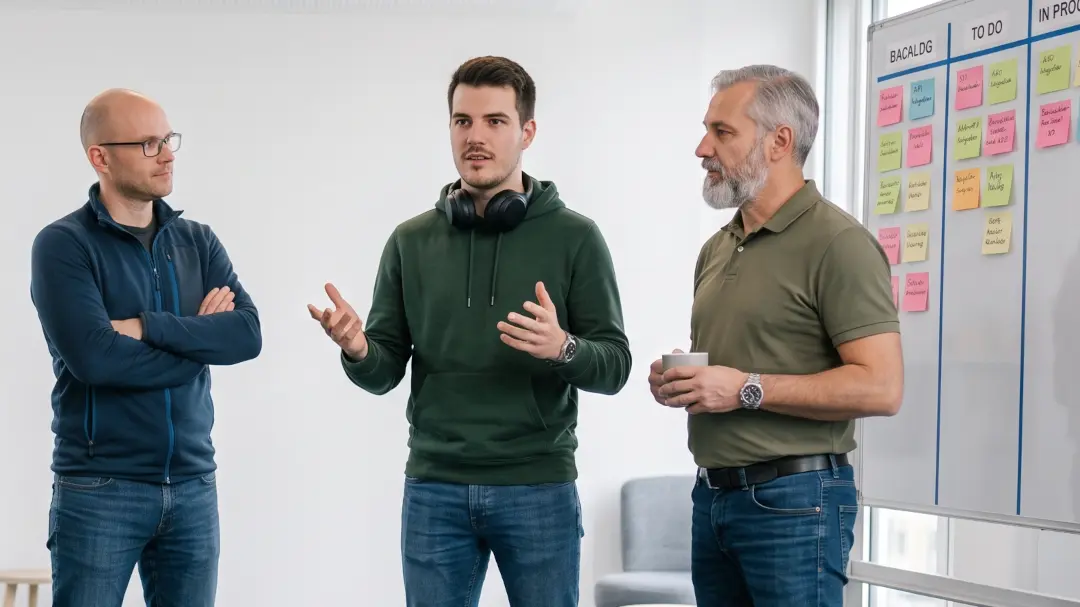
3. Apply it directly at work
Use the lessons and handouts whenever you face a challenging situation on the job. If you want, complete brief scenario assessments to unlock a certificate for your CV or LinkedIn.
Frequently Asked Questions
If you have shipped solid work and then watched someone else get asked the interesting question about it, this is for you.
The industry shift does not really leave you a choice. These skills have to be visible today, not next year. And there is an asymmetry worth noticing: AI can clean up your code. It cannot handle the conversation where you explain the tradeoff, push back on a bad ticket, or make your work visible to the person who decides what happens to your role.
That part is still on you, and it is the part that is getting scarce.
There is also a difference in how you learn the two things. With code you are alone first. You can fail quietly, take your time, rewrite it, ship it when it is good. With people there is no draft. It is live, the feedback is immediate, and the awkward version is the one everyone remembers.
The course exists so you skip the expensive version of that trial and error and show up prepared instead.
60+ lessons, 5 to 15 minutes each. No schedule, no live calls. One lesson fits in a break.
The lessons do not build on each other in a strict order. They are small, practical moves you can learn in a break and use in the next meeting.
We have had alumni tell us they got interviews, and in some cases the job, because they answered questions exactly the way they practiced in the course. The certificate made it official on paper.
We include a "convince your boss" template with the arguments already written out, and we invoice properly for company purchases, backed by the same 14-day money-back guarantee.
You do not need native-level English to follow it. The vocabulary is everyday engineering work, the kind of language you already use in code reviews, tickets, and team calls.
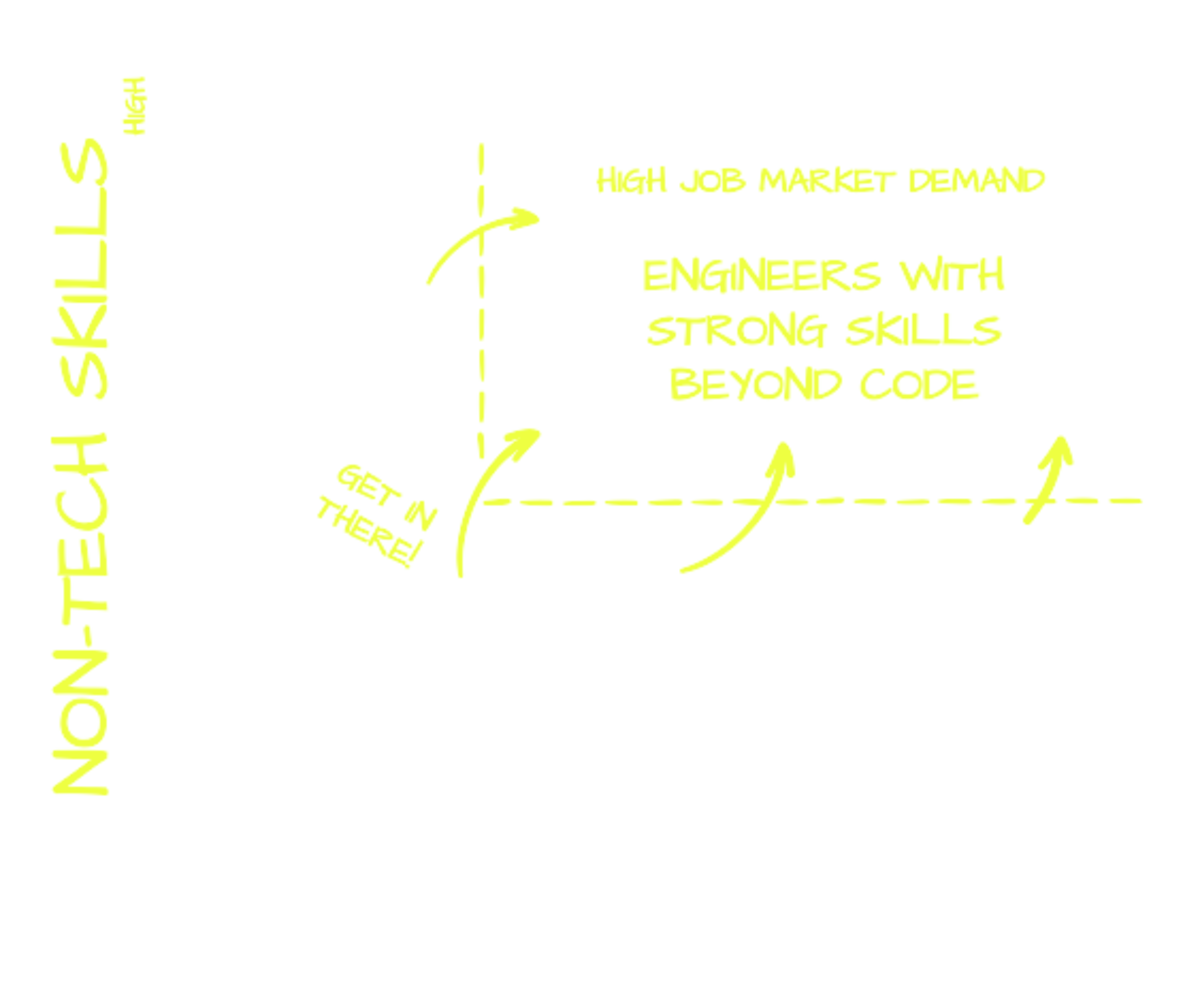
The Market Is Shifting To Senior-Only
"Senior" stopped meaning years of coding experience and started meaning judgment: deciding what to build, owning the outcome, making it land with people who don't code.
Everyone is racing to learn the AI half. Almost nobody is learning the other half, which is the half that decides who gets promoted.
€199, once. Lifetime access. 14 days to change your mind.
GET INSTANT ACCESSNeed your employer to pay? Use our "convince your boss" template.