Executive Summary (TL;DR): Soft Skills for Software Engineers
If you're short on time, this cheat sheet shows the 7 essential soft skills for software engineers (beyond code) - and how to start practicing each one this week.
| Skill | What it looks like at work | Practice this week |
|---|---|---|
| Strategic Career Vision | Choosing projects that build skills and visibility for your next level. | Write one sentence: “My next role is ___, so I'm optimizing for ___.” |
| Radical Focus & Prioritization | Pushing back on low-impact work to protect outcomes that matter. | Before starting a task, ask: “What breaks if this waits a week?” If nothing measurable, de-prioritize. |
| Outcome Ownership | Reducing repeat incidents instead of just shipping fixes. | Write a 5-bullet postmortem for a recent bug: cause, impact, fix, prevention, next step. |
| Bilingual Communication | Explaining technical trade-offs in terms of risk, cost, and timing. | Rewrite one message as: “If we don't do X, Y happens (impact) within Z (time).” |
| Multiplier Leadership | Unblocking others and spreading context so work doesn't depend on you. | When asked a question, don't answer immediately - share a link, pair once, or ask “what have you tried?” |
| Ego-Free Feedback | Treating critique as signal for improvement, not an accusation. | In your next review, reply first with: “What concern are you seeing?” |
| Business Acumen | Framing technical work as an investment instead of a cost. | Estimate a refactor's cost in hours vs. the cost of doing nothing (bugs, delays, support). |
What Are Soft Skills for Software Engineers?
Whether you're a software engineer, developer or programmer, these are the non-technical skills that determine career growth. Soft skills for software engineers are the human, communication, and decision-making skills that determine how effectively technical work turns into business outcomes. You will sometimes hear these described as skills beyond code, meaning the parts of the job that are not about syntax but still determine whether work has impact.
They become increasingly important as engineers move beyond individual contribution and into roles where influence, coordination, and prioritization matter more than raw coding speed.
In this guide, “soft skills” includes non-coding skills like prioritization, ownership, and strategic thinking, because those are what actually determine impact at senior levels.
In practice, that includes:
- Communication: Explaining technical concepts to non-technical stakeholders
- Leadership: Mentoring and multiplying team effectiveness
- Business Acumen: Connecting technical work to business outcomes
- Prioritization: Choosing high-impact work over busy work
- Collaboration: Working effectively across teams
- Feedback Reception: Using criticism to improve
- Strategic Thinking: Planning career growth deliberately
As engineers progress in their careers, technical skill stops being the main limiter. What increasingly determines impact and advancement is how well an engineer communicates, prioritizes, and influences decisions across teams. At senior and staff levels, most performance differentiation comes from these non-technical skills rather than from writing better code alone.
The Key Difference:
- Hard Skills = Speaking to the machine (Python, AWS, SQL, Kubernetes)
- Soft Skills = Working effectively with people and priorities (Communication, Influence, Ownership, Prioritization)
While hard skills determine what you can build, the soft skills software engineers need determine what you should build and whether anyone will use it.
Think of it this way: Your code might be perfect, but if you can't explain why it matters, convince stakeholders to fund it, or help your team maintain it, that code creates zero business value. Without these engineering soft skills, technical excellence doesn't turn into impact.
Why Software Engineers Need Soft Skills (And Why Code Alone Isn't Enough)
At senior levels, career growth in software engineering depends more on communication, judgment, and influence than on individual coding output.
You've optimized algorithms, refactored architecture, and automated tests. So why are you still stuck in meetings? Why do warnings about tech debt get ignored? Why did someone else get promoted when your code is objectively stronger?
Because beyond a certain point, writing better code stops being the bottleneck.
As software engineers become more senior, the job shifts. The work is no longer just about producing correct code - it's about influencing priorities, aligning stakeholders, mentoring others, and making decisions that scale beyond one person's output.
This is what many engineers run into as the “seniority ceiling”: a point where technical excellence alone no longer leads to advancement. Promotions at senior, staff, and principal levels depend on leading people and systems, not just shipping features. See our software engineer career ladder for what changes at each step.
Without strong soft skills, it's easy to become the person everything depends on - but nothing scales around. You stay busy, indispensable, and quietly stuck.
What Investing in Soft Skills for Software Engineers Actually Gets You
- Higher Influence: Your architectural decisions get approved because you frame them in business terms, not just technical ones.
- Less Burnout: You delegate effectively instead of staying the “only one who knows how this works,” freeing up your time for harder, more interesting problems.
- Faster Career Growth: You move from Senior to Staff or Principal levels because you multiply what the team can do, not just ship a lot of code yourself.
- Better Compensation: Promotion to Staff and Principal explicitly weighs influence, scope, and cross-team impact rather than code output alone, so these are the skills that clear the bar for those pay bands.
Many engineers experience burnout and dissatisfaction when they lack these skills. Discover why 80% of developers aren't happy at work and how soft skills can change that.
The Soft Skills Career Roadmap: What You Need at Each Level
Different engineering levels require different “stacks” of the soft skills software developers need. Here's what actually matters at each stage:
| Level | Primary Focus | Key Soft Skills Required | Common Failure Mode |
|---|---|---|---|
| Junior Developer | Learning & Delivery | • Asking for help effectively • Accepting feedback without ego • Understanding business context | Staying silent when blocked, then missing deadlines |
| Mid-Level Developer | Independent Execution | • Technical writing • Code review etiquette • Time management | Building “cool” features nobody asked for |
| Senior Developer | Architecture & Quality | • Technical communication • Mentoring juniors • Cross-team collaboration | Optimizing local systems while ignoring global priorities |
| Staff/Principal | Strategy & Alignment | • Influence without authority • Business acumen • Strategic thinking | Diving into code instead of unblocking the organization |
The Pattern: As you level up, you spend less time coding and more time communicating - clarifying priorities, aligning stakeholders, and unblocking others. The soft skills software engineers need at each level change, and developers who resist this shift often hit the ceiling.
The Smart Move: Don't wait until you need these essential soft skills for engineers to start building them. A junior developer practicing “influence without authority” on low-stakes decisions gets to fail safely and learn faster. By the time you're interviewing for Staff roles, these skills are already second nature, not something you're scrambling to learn under pressure.
Who This Guide Is For
This is most urgent for mid-level engineers who are tired of being told “you're doing great work” but not getting promoted, and for junior engineers who want to skip the 3-5 years most people waste figuring this out the hard way.
If you're mid-level and feeling stuck, these blind spots are likely what's blocking your next level.
If you're junior and deliberate about growth, building these habits now means you'll hit senior-level expectations in half the time because the transition will feel natural instead of sudden.
The AI Reality Check: Why Soft Skills Matter More as AI Grows
The entry-level technical work you trained on is exactly the part AI is absorbing fastest. Stanford's 2026 AI Index puts the drop in developer employment for workers aged 22 to 25 at nearly 20% since 2024, while headcount for more senior engineers grew. That is not the end of the job. It is the bar moving. On SWE-bench Verified, AI model performance jumped from roughly 60% to near the human baseline in a single year, which means writing syntax is now the baseline, not the differentiator. What now decides where you land is communication, ownership, and judgment, and those are exactly the skills AI is not replacing.
As AI coding assistants (like Copilot and ChatGPT) become standard, the baseline for “writing syntax” is being commoditized. AI can assist with communication and analysis, but it can't own alignment, judgment, or accountability.
- AI can write the function, but it cannot negotiate the requirements with a difficult stakeholder.
- AI can refactor the class, but it cannot convince the Product Owner to prioritize tech debt over new features.
- AI can generate tests, but it cannot mentor a junior developer through imposter syndrome.
As AI lowers the barrier to entry for coding, your ability to communicate, lead, and think strategically becomes what actually sets you apart. Understand why investing in human skills creates lasting competitive advantage in the AI era. Explore the complete framework of skills beyond code that define success in the AI era.
In practice: the engineers who stand out are the ones who clarify requirements, frame trade-offs, and reduce team friction.
Hard Skills vs. Soft Skills: What's the Difference?
Most engineers and programmers focus heavily on hard skills because they're clear-cut - code either works or it doesn't. Developer soft skills are messier and harder to measure, but they have a much bigger impact on your career over time.
| Feature | Hard Skills (The “What”) | Soft Skills (The “How”) |
|---|---|---|
| Examples | Python, Kubernetes, SQL, AWS | Communication, Empathy, Negotiation, Influence |
| Shelf Life | Often shorter (tools and platforms change quickly) | High (Lasts your entire career) |
| Focus | Interaction with machines | Interaction with humans |
| Outcome | You build the feature correctly | You build the right feature |
| Career Impact | Gets you hired | Gets you promoted (see: The 7 Essential Soft Skills) |
| Learning Curve | Steep initially, then plateaus | Gradual but compounds forever |
At every level, technical skills get you in the door, but the soft skills you develop determine how far you go.
Before the 7 Skills: Know Yourself First
All seven skills in this guide are learnable. But there's a prerequisite that rarely gets mentioned: you have to be honest about where you actually are.
Self-awareness in engineering means recognizing your genuine strengths - and being equally clear-eyed about your blind spots. It's knowing the difference between “I'm not good at this yet” and “I've decided this isn't for me.”
Self-learning follows directly from that honesty. When you know where the gaps are, you can close them deliberately - through targeted practice, mentorship, or simply pairing with someone stronger in an area you've been avoiding.
A quick check-in that helps:
- What have I been avoiding in the last few months?
- What feedback keeps coming up - even when I disagree with it?
- Where am I actually learning, and where am I just repeating?
Without this foundation, skill-building tends to reinforce what you're already comfortable with rather than closing the gaps that actually matter. Engineers who do this consistently don't just grow faster - they become easier to promote, because their managers can see them actively closing gaps instead of waiting to be developed.
The 7 Essential Soft Skills for Software Engineers
We've looked at what actually works for engineers who grow. These are seven patterns that show up again and again.
Who needs these skills most?
Mid-level engineers starting to feel friction and junior engineers who want to grow faster than average.
If you're early in your career, you won't be negotiating tech debt or mentoring yet - and that's fine. You can practice these on smaller surfaces: explaining your work clearly in standups, asking better questions when blocked, noticing which tasks change outcomes versus fill your queue.
Engineers who practice early tend to hit senior-level expectations faster because the transition feels familiar instead of abrupt.
1. Strategic Career Vision
The problem
You don't consciously choose your next step. You take the next ticket, the next project, the next promotion cycle, and hope it adds up to something.
For a while, that works.
Then one day you realize you've been “senior” for years, your work looks the same, and you can't clearly explain what you're building toward.
I went through a version of this myself. About a year and a half into being a group leader, I made a deliberate call the other way: I told my managers I wanted to focus on coding, and spent the next couple of years deep in the senior IC path.
That wasn't drift. It was a real decision. But it wasn't the only one I needed to make.
Somewhere in those years, it got clear to me that I didn't want to be just the coder. My manager kept pointing out that the work was good and that I'd earned real trust across the company from that senior IC role, which helped confirm it, but the clarity was mine. I started actively checking out what paths were actually open to me: not just writing good code, but having a say in what we built and how, setting standards, building a team. That kind of influence had a bigger impact on the company than quiet, heads-down coding ever would.
The fix
You don't need a grand vision statement. You just need to stop outsourcing your direction to chance and your manager's backlog.
For me, that meant getting clear on what I didn't want - being just the coder - and then actively checking out what other paths were actually open, instead of waiting for one to show up. That's what led me off the hard-core coding track I'd been on for a couple of years, toward a role where I could shape decisions instead of just executing them well.
Engineers who grow tend to step back periodically and ask whether the work they're doing is actually moving them closer to the kind of role they want next, or just keeping them busy.
A simple way to do this
Every few months, take 30 minutes and answer these honestly:
- What did I work on recently that actually changed how people see or rely on me?
- What's the one thing I keep getting feedback about - good or bad?
- If I stayed on my current path for another year, would I be happy with where I'd land?
If you can't answer those questions clearly, that's usually the signal - not that you're failing - but that you're drifting.
Time pressure is where prioritization, communication, and decision-making get stress-tested. We break this down concretely in time management for software engineers.
Engineers who never pause to choose a direction don't fall behind because they're bad at their job. They fall behind because they let other people decide what “progress” looks like.
2. Radical Focus & Prioritization
The problem
Being busy is often a sign of poor prioritization. Clearing a long list of low-value JIRA tickets feels productive, but it usually means reacting to whatever shows up first.
Early in my career, that's exactly what I did. Tickets came in, I took the next one, and repeated. My board always looked full, but very little of that work changed anything in a lasting way.
What changed
At some point, I stopped taking tickets in the order they arrived and started sorting them deliberately.
I used a simple version of the Eisenhower matrix:
- urgent and important
- important but not urgent
- urgent but low impact
- neither
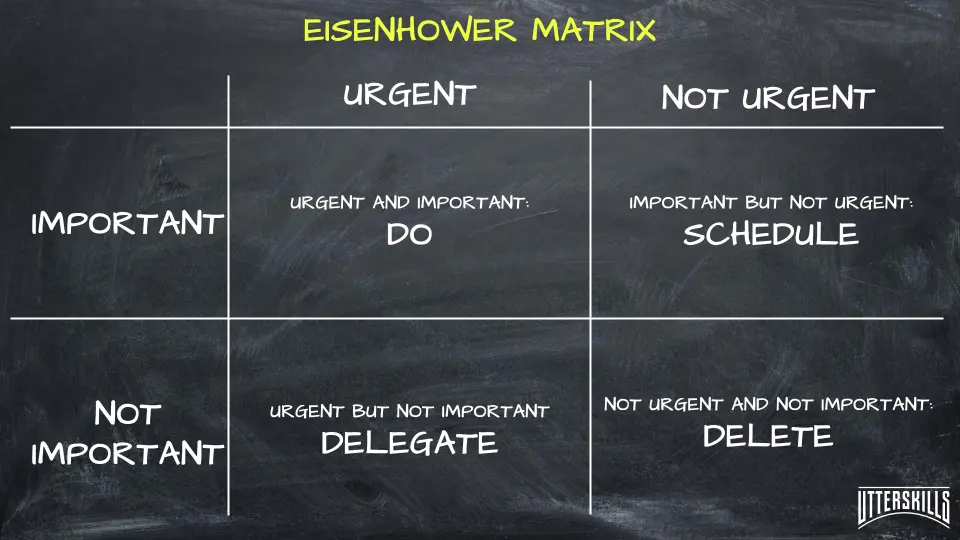
Eisenhower matrix: sort work by urgent and important to focus on what matters
Most tickets ended up in the last two buckets.
That was the first time it became obvious how much work existed simply because no one questioned it.
The problem wasn't focus or effort. It was that every task was treated as legitimate by default.
Once I started asking why a piece of work existed—who it actually helped and what would break if it didn't get done—entire categories of busy work disappeared.
Prioritization means deciding what doesn't deserve attention in the first place, not getting better at doing more of it.
What this looks like in practice
When a new “high priority” item came in, I stopped asking how fast I could do it and started asking:
- What breaks if this waits?
- Who is actually affected?
- What happens if we do nothing for a week?
If the answers were vague, the work usually was too.
The result
I closed fewer tickets, but I spent less time revisiting the same problems. Things didn't bounce back as often, and I wasn't constantly context-switching.
In reviews, the feedback shifted. Less “you got a lot done” and more “you picked the right things to work on.”
That mattered more than raw output.
3. Outcome Ownership
The problem
A lot of engineers quietly operate with a boundary in their head: my responsibility ends when the code is merged.
So when something breaks in production, the instinct is to jump in, fix it quickly, and move on. The ticket is closed. The incident fades. Everyone's busy again.
The system stays fragile.
The fix
Outcome ownership is the shift from fixing individual incidents to reducing the chance that the same type of incident happens again.
It's not about blame or heroics. It's about recognizing that the real work isn't just making the error go away - it's making sure the same class of problem doesn't keep resurfacing.
Engineers who get trusted with more don't just fix incidents. They reduce the likelihood that the same incident happens again.
What this looks like in practice
I ran into this owning a payments service: code I hadn't written, that a lot of people depended on without ever thinking about it.
For a while it was patch-and-move-on: a manual workaround someone was quietly running by hand, money that had never actually been collected sitting buried in a clunky system. I'd go in, fix whatever had broken, and move on. It worked every time, until the next thing broke the same way.
Eventually I realized the fixes weren't the problem. None of what I knew about the system lived anywhere except my head.
So I did something different:
- traced the actual root cause instead of patching the symptom each time
- documented what was breaking and why, not just the workaround
- stepped up and said the reliability work needed priority
People listened. The work got scheduled instead of quietly absorbed into whatever I was already doing that week. Payments started getting handled properly. Manual workarounds stopped being necessary, and customer money that used to sit uncollected and unnoticed in the system started getting caught.
The result
Two things changed:
- The system actually improved, because the underlying cause finally got addressed
- I stopped being the silent firefighter and started being the person who made the system safer for everyone
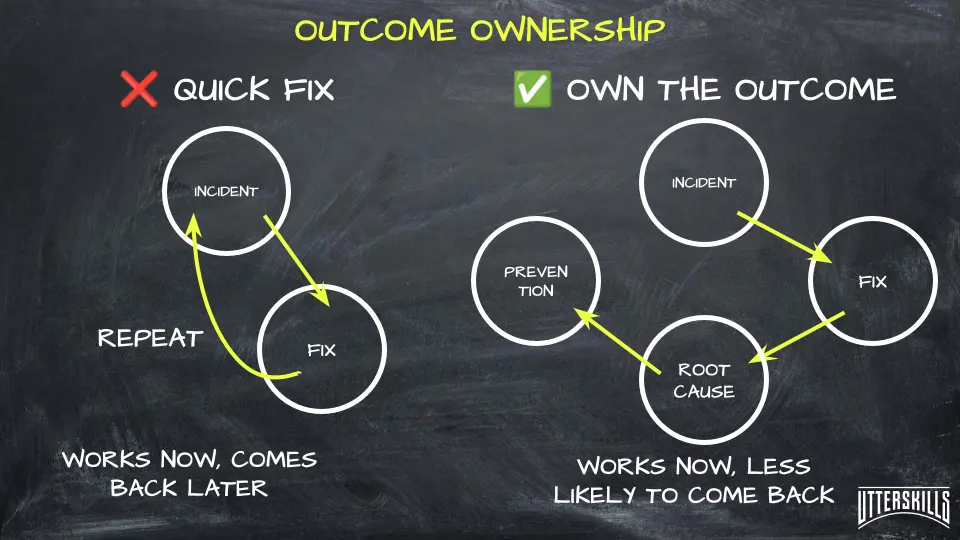
Outcome ownership: fix the cause, not just the symptom
That's the shift from “I fixed it” to “we don't have to keep fixing this anymore.”
Engineers who make that shift are trusted with larger systems - not because they work harder, but because they make fewer problems repeat.
Accountability goes hand-in-hand with ownership. Explore why accountability is essential for engineers.
4. Bilingual Communication
The problem
Most of us explain technical problems the way we think about them. That works fine with other engineers, but it often falls flat outside the team.
So we say things like “technical debt” or “we should refactor this,” and then wonder why it keeps getting pushed out.
The fix
The issue usually isn't that we're too technical - it's that we're describing structure instead of consequences.
People making decisions are listening for things like risk, cost, timing, and customer impact. If we don't connect our concerns to those, they're easy to ignore.
What this looks like in practice
Instead of:
“This part of the system is brittle and hard to maintain.”
Try:
“This part of the system causes a lot of incidents. When it breaks, checkout fails and support gets involved.”
Same problem. Same code. Different outcome.
This is a core communication skill for software engineers. Read more: Communication skills for software engineers
Here are more examples of how to translate engineer shorthand into language that lands better with stakeholders:
| Engineer shorthand | What actually lands better |
|---|---|
| “We have tech debt” | “This part of the code is why we keep touching the same bug every sprint.” |
| “We need to upgrade the framework” | “We're blocked on bug fixes because the current version isn't supported anymore.” |
| “This code is unmaintainable” | “Only two people feel comfortable changing this without breaking something.” |
| “We should refactor this” | “Right now small changes here take days instead of hours.” |
| “This system doesn't scale” | “We start seeing failures as traffic spikes, especially during peak usage.” |
| “We need better tests” | “We usually find issues after release instead of before.” |
| “We should use microservices” | “Deploying a small change currently risks the whole system.” |
A simple habit
Before bringing up a technical concern outside the engineering team, ask yourself:
- What breaks if we don't fix this?
- Who feels it first?
- How often does it happen?
You don't need perfect numbers. Rough answers are usually enough.
When you do this consistently, discussions shift from whether something matters to when it should be addressed - and you stop feeling like you're arguing for “nice-to-have” work.
Understanding your audience is crucial. Learn the secret to winning every meeting by knowing who you're speaking to.
Poor communication is a leading cause of project failure. Learn why 70% of IT projects aren't fully successful and how to prevent it.
5. Multiplier Leadership
The problem
At some point, many engineers become “the person who knows how this works.” It feels useful at first.
Over time, it turns into a bottleneck. Every question, change, or incident routes through you. The team slows down, and you cannot step away without things piling up.
The fix
Reducing how often things depend on you specifically matters more than managing people directly. Knowledge sharing is key to reducing dependency. Learn practical strategies for breaking down knowledge silos.
In practice, that often means resisting the instinct to jump in and solve things yourself. When someone asks a question you could answer quickly, the move that helps more in the long run is often to slow down and either point them to existing context, pair once so they can do it next time, or ask them what they've tried so far.
What this looks like in practice
Over time, you start capturing the patterns:
- what the system does
- why it exists
- the few rules you follow when changing it
The point isn't to write docs - it's to respond in a way that spreads knowledge.
The result
Interruptions drop. Other people gain confidence touching the system. You get space to work on harder problems that affect the whole team.
The engineers who help the most aren't the ones who know everything. They're the ones who make it easy for others to learn.
6. Ego-Free Feedback & Emotional Intelligence
The problem
Most of us don't think we're defensive. We think we're explaining. In code reviews especially, it's easy to slip into “let me justify this” mode. The problem is that once you're busy defending your approach, you stop hearing what the other person is actually pointing out. That's usually when learning stalls.
But there's a deeper layer. Early in my career, I assumed that if my code was correct and my arguments were logical, I'd get buy-in. I was wrong. I'd push back on feedback too fast. I'd miss that a colleague was already overwhelmed when I dropped a “quick question” on them. The problem wasn't the logic. It was that I wasn't reading the room.
The fix
Treat feedback the same way you treat a bug report. It's not an accusation - it's information about how the system behaved from someone else's point of view. You don't have to agree with every comment. You just have to understand it before responding.
This is really emotional intelligence in practice. It means two things:
- Managing yourself - catching the moment you're about to get defensive, or recognizing that you're rushing an explanation because you're stressed.
- Reading others - noticing when a teammate is quiet in a way that means something, or when a stakeholder's hesitation isn't about the technical details at all.
What this looks like in practice
When someone questions your approach, the instinct is to explain why you did it that way. A better move is to pause and ask:
“What's the concern you're seeing here?”
That single question changes the tone of the conversation. You're no longer defending a decision - you're trying to understand the problem. Before responding in any tense moment, ask yourself what the other person is actually trying to protect or solve. Not what they said - what they need.
The result
Engineers who do this consistently have smoother reviews, catch issues earlier, and get more thoughtful feedback in return. And it compounds beyond the team - non-technical stakeholders respond differently to engineers who actually listen. That's what makes high-EQ engineers easier to work with, and easier to promote.
For a deeper look at how to receive criticism without ego, read how engineers can use feedback as a growth tool.
7. Business Acumen
The problem
When we argue for technical work, we usually explain why the code is bad. That rarely changes priorities.
It's not that leadership doesn't care. It's that we haven't connected the issue to cost, risk, or impact.
The fix
Think about what the current situation is costing the team right now.
Time lost to bugs, features delayed, incidents repeated. You don't need perfect numbers. A rough sense of the trade-off is usually enough.
In practice
Instead of:
“This needs to be refactored.”
Try:
“We keep spending time fixing the same problems here. Cleaning this up would free that time for other work.”
When you frame it this way, the conversation usually shifts from whether the work matters to when it makes sense to do it.
Getting buy-in for technical work requires business acumen. Learn how to effectively pitch refactoring to management.
Engineers who do this get trusted with bigger decisions instead of fighting for cleanup.
Frequently Asked Questions About Soft Skills for Software Engineers
Final Note
Most developers don't stall because they stop learning new tools.
They stall because the things that limit their impact stop being technical. That's when communication, ownership, and influence become the real differentiator.
At some point, writing better code doesn't change much. What changes things is how you choose work, how you explain problems, how you handle feedback, and how much friction you remove for the people around you.
That's all these seven essential soft skills for software engineers really are.
You don't need to work on all of them. If one section felt uncomfortably familiar, start there. Make one small change and see what happens over the next few weeks.
Careers usually don't plateau suddenly. They drift there.
This is just a way to notice that drift earlier and correct it while it's still easy to change direction - by building the soft skills for software engineers that turn good code into real impact.