Every list of software engineer skills starts with languages and frameworks. That part is real. It's also the part you already know how to learn.
Friday afternoon. Your feature is merged, the tests are green, the reviewer left a thumbs-up. On Monday the product manager opens it in the demo and goes quiet. “Hm. That's not really what we meant.” Nobody did anything wrong in the code. The ticket said one thing, the PM pictured another, and you built the version in your head. Two more days of rework, and a small feeling that you should have seen it coming.
That gap, between working code and the right result, is where most of the skills needed to be a software engineer actually live. This post covers both halves: the technical baseline every role expects, and the skills beyond code that decide who gets trusted with more.
What skills are needed to be a software engineer?
A software engineer needs two layers of skills. The first is the technical baseline: one programming language you know well, data structures, SQL and databases, Git, testing, debugging, APIs and basic security. The second decides how far you go: communication, ownership and judgment. That means understanding what a problem really is before you code, writing so people act on it, handling code review in both directions, and connecting your work to what the business needs. On top of both sits a learning habit, because the tools will change under you anyway.
The first layer gets you hired. The second gets you trusted. And with AI writing a growing share of the code, the second layer is showing up much earlier in a career than it used to.
The technical baseline: fundamentals before frameworks
Languages come and go, fundamentals stay. Variables, control flow, functions, data structures, error handling, modularity, and the habit of breaking a big task into small steps. Once those click, a new language is mostly new syntax.
Good starting points haven't changed much: Python for scripting, automation, data and back-end work, JavaScript or TypeScript for anything web, Java and C# for a lot of enterprise systems, C++ where performance matters. Go and Rust are worth a look once you know where you're heading, Go for cloud services, Rust for systems work where memory safety counts. SQL isn't optional for most roles, because almost every product stores and queries data somewhere.
You don't need all of them. A learning order that works:
- Pick one main language and build small programs with it.
- Learn the core data structures: arrays, maps, sets, stacks, queues, trees, graphs.
- Practise algorithms until you can reason about efficiency, not just pass interviews.
- Add SQL and basic database design.
- Build one complete project that takes input, stores data, handles errors and has tests.
- Only then add a second language.
Around the code sit the working practices that make it dependable. Git, because teams track, review and undo changes through it. Testing, unit, integration and end-to-end, because tests are what let you change code without fear. Debugging, done like a scientist: observe the failure, form a hypothesis, change one thing, check. Randomly editing until it works feels fast and leaves hidden problems behind. Add a working picture of APIs, databases, networking and deployment, even if you're front-end, and basic security habits: validate input, keep credentials out of the repo, handle permissions carefully, keep dependencies updated.
Once that's in place, cloud, CI/CD, containers and AI tooling make you more useful fast. You don't need to be a cloud architect. You need to know what an environment is, why a pipeline fails, and where an AI-generated answer can be confidently wrong.
We leave most of this out of the Utterskills course on purpose. Not because it doesn't matter, but because it's covered well in a hundred other places. What follows is the part that usually isn't.
Problem-solving starts before the first line of code
Most engineers think of problem-solving as the algorithm part. In practice, the expensive mistakes happen earlier: two people leave the same meeting with different pictures in their heads and nobody notices.
Try it with your team. Ask everyone to draw a truck. You'll get a pickup, a semi, a fire engine and a toy. Now imagine that happening with “the export should include all orders”. NASA lost the Mars Climate Orbiter in 1999 because one team worked in imperial units and another in metric. Smart people, clear spec, different assumptions.
So the first problem-solving skill is making sure you're solving the right problem:
- Restate the request in your own words before you start. “So you want X, for Y, and it's done when Z. Right?”
- Ask the how questions. How will someone use this? How do we know it worked?
- Build a shared vocabulary. Domain-driven design calls it ubiquitous language: one term, one meaning, used by devs and business alike.
- Sketch it. A quick drawing surfaces the mismatch in two minutes instead of two sprints.
Then the classic habits kick in: write down what you know, what you assume and what you've tried, reproduce the bug in the smallest possible case, and choose the simple solution nobody is afraid to change over the clever one only you understand.
Which software engineer soft skills matter most?
The software engineer soft skills that matter most are communication, ownership and judgment. In the daily work that means writing messages people read and act on, giving and receiving code review without it getting personal, being someone the team can rely on, and explaining technical decisions in terms of what they cost or earn. We cover the full set, with more detail per skill, in our deep dive on soft skills for software engineers.
We don't love the word “soft” for these. There's nothing soft about telling your lead a deadline won't hold, or about the review comment that decides whether a colleague trusts you next time. These are the skills that decide who gets the interesting work.
Write so people act on it
A big part of your week is written: PR descriptions, tickets, chat, docs. And written messages get misread far more often than their authors think. People are usually sure their message was clear. The reader often isn't. We go deeper on this in our post on communication skills for software engineers.
The fix is structure before typing. BLUF, bottom line up front: start with the conclusion or the ask, then the context, then details, then what you need from the reader and by when. “Blocked on the payment API, need access by Thursday to hit the release” beats three paragraphs of backstory that end in a question. And if you're angry, don't send it. Tone survives in writing, the context that explains it doesn't.
Handle code review in both directions
Code review is where a junior's relationship with the team gets built. On the giving side, use COIN: context, observation, impact, next step. “This is amateurish” becomes “In the checkout handler (context), the retry has no limit (observation), so a flaky API could lock up the worker (impact). Could we cap it at three? (next step)”. Same point, and the author actually wants to fix it. It works for praise too: “great job” says nothing, “the way you split the migration made this easy to review” gets repeated.
On the receiving side, the first reaction to criticism is usually ego, not analysis. Don't answer straight away. Let it sit, then sort what you got: constructive feedback is free advice, low-quality feedback you can note and move past, and personal attacks say more about the sender than about your code.
Be the one people can rely on
Here's something that surprises many strong coders: when teams pick people for important work, trust usually beats raw output. A top performer nobody wants to work with gets passed over for someone slightly less brilliant whom everyone relies on.
Trust is built in unglamorous places. Come to meetings prepared and say something. Volunteer for the work nobody counts: onboarding the new hire, sitting in on an interview, following up on the retro action. And if you're the quiet one with the good ideas, being unheard is a problem you can fix yourself. Start in writing, then in small groups, then in the bigger meeting.
Connect your work to money
Engineers tend to rank business acumen last. Managers rank it near the top. That gap explains a lot of rejected proposals. “We need to refactor the auth module” goes nowhere. “Hotfixes in auth cost us about a day every sprint, a two-week cleanup pays for itself in a quarter” gets scheduled.
This is judgment in practice: knowing that every decision is also a business decision, and saying it in the language of the person who has to approve it. Technical debt is the classic case. Explain it with an analogy the listener knows, a house built on cheap foundations, then name what it costs in speed, in reaction time, in hiring.
A peer story: from rework to refinement
A story we heard in several versions from the engineers we interviewed for the course. Call her Lena. It's a composite, but every piece of it happened to someone.
Lena came out of a bootcamp and was technically sharp. Her first six months had a pattern: tickets done quickly, then sent back. “Works, but not what we needed.” She assumed the problem was speed and started working longer.
What changed it was small. Before starting any ticket bigger than a day, she posted three lines in the ticket: “My understanding: X. Done when: Y. Open question: Z.” Sometimes she added a rough sketch. The first week, the PM corrected two of her three summaries. That stung a bit. It also saved her about four days of rework that sprint.
Two sprints later the send-backs had mostly stopped. A month after that, her lead asked her to write up the refinement notes for the whole team. Nothing in her code had changed. What changed was that people started to see her as someone who gets it right the first time.
Role-specific skills: where to go deep
Once the baseline and the skills beyond code are in place, your role decides where you go deeper:
| Role | Technical focus | Skill beyond code that matters most |
|---|---|---|
| Front-end | TypeScript, HTML, CSS, accessibility, state, performance | Working with design, understanding real user behaviour |
| Back-end | Data modelling, APIs, auth, performance, reliability | Explaining trade-offs and risks to non-engineers |
| Full-stack | Breadth across UI, server and data | Judgment about when to go deep and when not to |
| Mobile | iOS, Android, cross-platform, device limits, store releases | Handling release pressure and product input |
| DevOps / platform | Infrastructure, CI/CD, observability, developer experience | Serving internal teams as your customers |
| Data / AI / ML | Data processing, statistics, experiments, model evaluation | Being honest about uncertainty and where a model fails |
| Security | Threat models, secure architecture, risk analysis | Saying no in a way people accept |
If you're unsure which way you lean, ask what kind of problems give you energy: visual feedback and users, systems and data, or connecting many parts. And for what each level expects of you on the way up, see our software engineer career ladder.
How to show these skills without much experience
Hiring managers want proof you can finish things, make sensible decisions and explain them. Three polished projects beat ten half-finished ones. Make them look like real software: user input, stored data, auth, tests, error handling, deployed somewhere.
The README is where the second layer shows. Most candidates list technologies. Write what problem the project solves, what you decided and why, what was hard and how you got through it, and what you'd do next. That's written communication and judgment, visible before anyone meets you.
A quick checklist:
- Each project has a clear purpose, not just a tech list.
- The repo is tidy and runs with the steps in the README.
- The README explains decisions in plain language.
- There are meaningful tests, or a note on what you'd test next.
- At least one project is deployed or shown in a demo.
- The commit history shows steady progress, not one big upload.
Open source, hackathons and volunteer projects count too, especially where you had to read someone else's code, follow their rules and respond to review.
In interviews, the same applies. Talk through your reasoning while you solve the problem. Interviewers are watching how you think and how you communicate under pressure, not only whether the code compiles. For the behavioural questions, prepare real examples of disagreement, ownership and a mistake you learned from.
Keep learning without chasing everything
Everything you know will age, some of it fast. That's not a reason to chase every new tool. It's a reason to build a habit.
Take a routine you already have, the one where you check news or scroll a feed, and point 15 minutes a day at curated sources for your field. Consistency beats intensity. Before starting something new, check why: curiosity carries you further than “everyone's doing it”. And expect the dip: excitement, overconfidence, then a valley where it feels like you'll never get it. That valley is normal, it's not a sign to quit. Then build something with it, because watching a tutorial doesn't make you able to do it, the same way you wouldn't fly with a pilot who only watched the video.
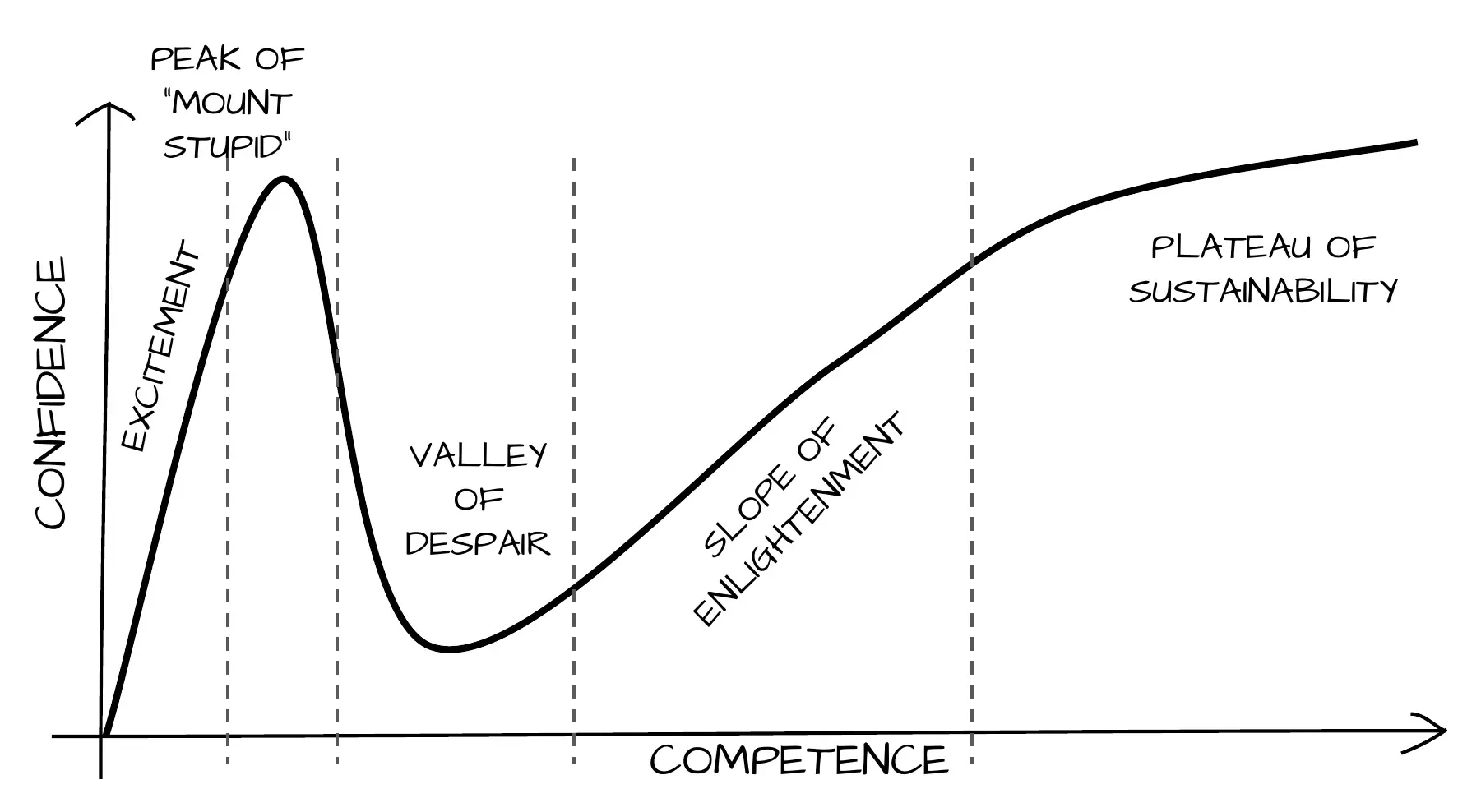
The Mount Stupid curve: confidence peaks early on very little real skill, dips through the Valley of Despair, then rebuilds more slowly as competence actually catches up.
The split isn't going away
The technical baseline hasn't stopped mattering. It's becoming the entry ticket. AI tools draft more of the code every quarter, and that makes the parts they can't do more visible: understanding what the problem really is, explaining a risk so someone acts on it, reviewing work with care, and taking responsibility for what ships.
That's not the job disappearing, it's the split between the two layers getting sharper. Knowing a language still gets your resume read. What decides whether you're still relevant in five years is the half nobody put on a syllabus, and it's learnable like anything else.
What to actually do this week
Pick one of these and do it visibly for the next few weeks.
Before your next ticket, write three lines. “My understanding, done when, open question.” Post it where the PM or your lead will see it.
Rewrite your next PR description BLUF-style. First line: what this changes and why. Then context, then what reviewers should look at.
Use COIN in your next code review. One comment, with context, observation, impact and a suggested next step. And add one specific piece of positive feedback.
Translate one technical concern into cost. Next time you want to fix something, say what it costs the team per sprint if you don't.
Set up your 15 minutes. One curated feed, one fixed slot in the day.
None of these needs permission or a new title. They just need to happen where people can see them.
Utterskills trains the skills beyond code that decide who advances: communication, ownership, and judgment. Built for devs, usable the same day.